
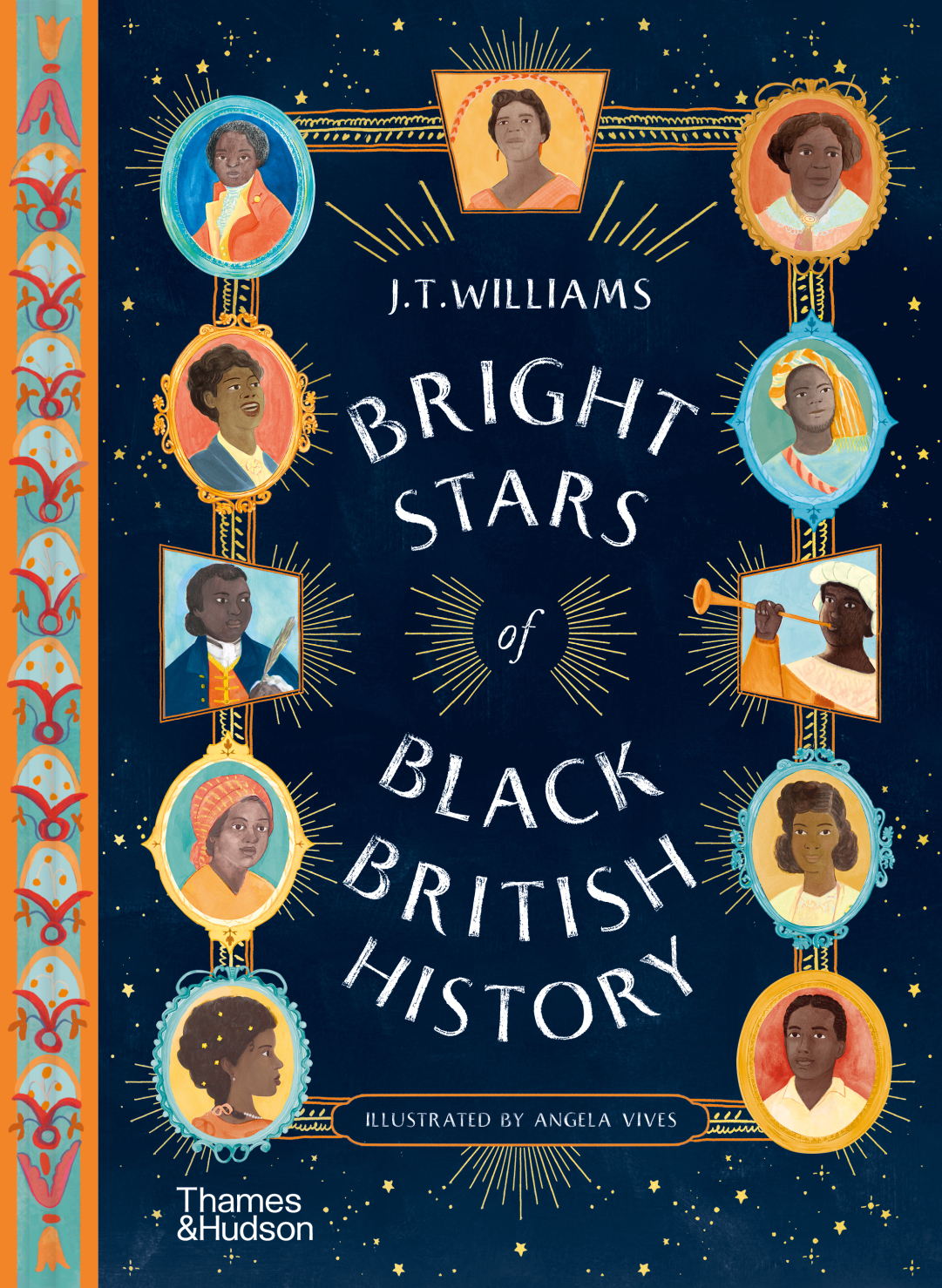
3rd September 2023 Ages 9+ | £16.99 Hardback | 60 illus 160pp | 24.0 x 17.2cm
A dazzlingly illustrated collection presenting the extraordinary life stories of fourteen bright stars from Black British history, from Tudor England to modern Britain.
Brought to life through hand-painted illustrations by award-winning illustrator Angela Vives, this important and timely book from author and educator J. T. Williams brings the lives of fourteen shining stars from Black British History into the spotlight, celebrating their remarkable achievements and contributions to the arts, medicine, politics, sport and beyond.
Featuring a constellation of iconic individuals – including storytelling freedom fighter Mary Prince, football star and World War I soldier Walter Tull, and Notting Hill Carnival founder Claudia Jones – ‘Bright Stars of Black British History’ shines a light on the courage, resilience and talent of remarkable individuals who have left a lasting mark on our collective history.
By Amanda J Thomas Imprint: Pen & Sword History Pages: 280 ISBN: 9781473875678 Published: 23rd June 2020
Blurb
The Nonconformist Revolution explores the evolution of dissenting thought and how Nonconformity shaped the transformation of England from a rural to an urban, industrialised society.
The foundations for the Industrial Revolution were in place from the late Middle Ages when the early development of manufacturing processes and changes in the structure of rural communities began to provide opportunities for economic and social advancement. Successive waves of Huguenot migrants and the influence of Northern European religious ideology also played an important role in this process. The Civil Wars would provide a catalyst for the dissemination of new ideas and help shape the emergence of a new English Protestantism and divergent dissident sects. The persecution which followed strengthened the Nonconformist cause, and for the early Quakers it intensified their unity and resilience, qualities which would prove to be invaluable for business.
In the years following the Restoration, Nonconformist ideas fuelled enlightened thought creating an environment for enterprise but also a desire for more radical change. Reformers seized on the plight of a working poor alienated by innovation and frustrated by false promises. The vision which was at first the spark for innovation would ignite revolution.
My Review
I received this book in 2020 from the publisher in return for an honest review. It has taken me a long time to read it. I have been reading in in bursts, a chapter or two at a time around other reviewing commitments and work.
This review is all over the place. I have just finished the book. It took me 3.5 years to read the first ten chapters (140 pages) and less than a day to read the last five (68 pages); I’m a bit confuddled.
The book covers developments from the 1300s to the 1800s, in dissenting religious groups and industrial development, and makes the argument that without the unconventional thinking and organisational support Nonconformists and ‘heretics’ provided to each other, England would not have become the driver of Industrial revolution that it was in the early 18th to late 19th century that it was. The focus is on England, the interactions between England and Continental ideas and people, England and the North American colonies, England and France (because, 1066 and all that). It doesn’t look at technology developed in any of the colonies (usually derived from indigenous or enslaved peoples’ knowledge).
There are some interesting ideas in this book:
The author points out the complex family networks of the Midlands and northern Nonconformist families who supported each others’ business ventures and encouraged/funded new developments in ironworks, among other things. The relationships were longstanding and lucrative for many of the families. The connections went from the Tyne to the Severn, through Liverpool, Manchester, Sheffield, Birmingham and Bristol.
The literacy encouraged by Protestant beliefs – that people should be able to read the Bible in their own language – encouraged education in these families and that enabled people to question social structures and norms, as well as make scientific breakthroughs.
Every group looks back to a golden age of freedom and liberty – the Peasant’s Revolt (which was more of a middling sorts revolt with villainage cannon fodder) looked back to a pre-Norman England, the Nonconformists of the 18th century valourised the Puritanism of the Republic. They never were golden ages, there were always tyrants and inequality and war.
The author doesn’t mention much about the slave trade, although some of the Nonconformist families made their money from making guns and cannons, supporting the East India Company and the slave trade. At least one person mentioned, from the 1700s, was disowned by his Quaker congregation for inheriting a gun company and supporting the slave trade. It is safe to say that without the triangular trade a lot of people wouldn’t have had the funds to support the new products produced by Wedgwood, or fund the research of Priestley and the Lunar society (amongst others). The focus of the book is so narrow that the author can’t bring these considerations into the text. I don’t know if that is a good or bad thing. She does mention the above, but briefly, with no exploration. A wider exploration of the developing empire might have added context.
The final two chapter focus heavily on Thomas Paine, his adventures in North America and France, who he knew and what he wrote. Amanda J. Thomas explores the possible developments of his radical thought from his Quaker upbringing to his return to North America in 1800 after imprisonment in France. The author connects his activities to the rise and fall of radical organisations, especially those in Sheffield, demanding governmental reform. As we all should know, the government of the time, and for decades afterwards, was very opposed to any reform, cracking down heavily, violently against anything that would put the high church gentry and the aristocracy out of control. And yet, people kept dissenting…
There were times when the book felt disjointed, as though it were a collection of essays arranged chronologically, and at other times several chapters would naturally follow from each other. This may be an artifact of the development of the book?
The writing is decent and the story is really interesting. What I think slowed me down was all the family trees (tangled shrubs in some cases) that the author felt the need to write out and share with us in the main text. I don’t think it was always necessary to getting the ideas across clearly and could possibly have be left to an appendix, along with the visual representations of the family trees.
The book has a good bibliography and indexing, notes are clearly identified and information sourced. The author has relied heavily on some sources more than others, usually those about specific families or individuals, which gives a possibly partial impression of events, but also provides interesting nuggets of information about individuals and the social and cultural dynamics of their times. I did not know that Joseph Priestley knew Thomas Paine and Thomas Jefferson, for example, or that Benjamin Johnson was a member of the Royal Society at the same time. I knew Erasmus Darwin and Wedgwood knew each other, because of the weird family dynamics of Charles Darwin and his cousin-wife. In-bred the lot of them -the Wedgwoods, Darwins and Galtons.
So, final thoughts. Interesting ideas and social history that tries to illuminate the development of the co-occurring scientific, religious and political though that brought about the 18th and 19th century Industrial Revolution in England, and makes some attempt to put it into the wider North Atlantic context. Quite well written and extensively researched. Excellent bibliography. Could do with some editing.
Also, I noted some references that make it into Discworld.
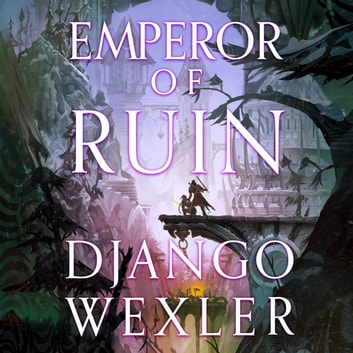
) Published February 28th 2023 by Head of Zeus Hardcover, 460 pages Author: Django Wexler ISBN: 9781801101424 Format:460 pages, Paperback Published: February 28, 2023 by Orbit ISBN: 9780316519663 Publisher : Head of Zeus — an AdAstra Book (9 Nov. 2023) Paperback : 528 pages ISBN-10 : 1801101442 ISBN-13 : 978-1801101448Format: Audiobook Published: August 8, 2023 by Orbit ISBN:9781668634899
Blurb
Two siblings divided by magic and revolution must finally join forces and rally the people to take down the Twilight Order once and for all in the final book of this brilliantly imagined epic fantasy trilogy. The last surviving Chosen, Ashok has finally risen up and taken control of The Twilight Order. He promises equality and prosperity, but Gyre and Maya know the truth. Only death follows in Ashok’s wake. To take him down, Gyre will have to unite old allies from all across The Splinter Kingdoms and the depths of Deepfire. And Maya will have to seek out a legendary weapon hidden in the mountains that could turn the tide in their battle for freedom.
Format: 352 pages, Paperback Published: November 7, 2023 by Tor Trade ISBN: 9781250886101 (ISBN10: 1250886104) Language: English
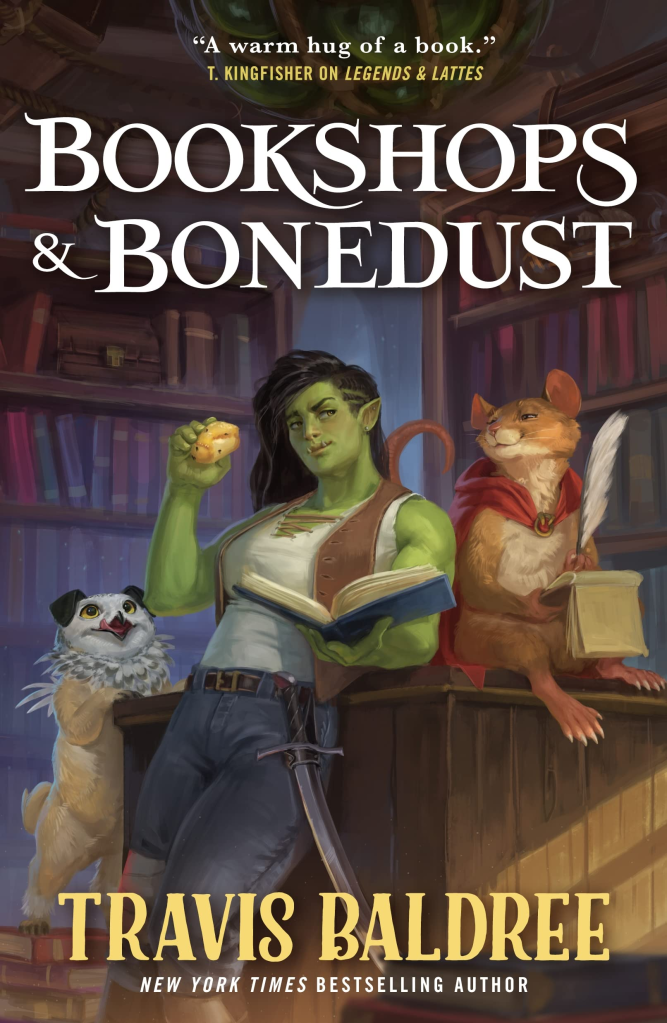
When an injury throws a young, battle-hungry orc off her chosen path, she may find that what we need isn’t always what we seek.
In Bookshops & Bonedust, a prequel to Legends & Lattes, New York Times bestselling author Travis Baldree takes us on a journey of high fantasy, first loves, and second-hand books.
Viv’s career with the notorious mercenary company Rackam’s Ravens isn’t going as planned.
Wounded during the hunt for a powerful necromancer, she’s packed off against her will to recuperate in the sleepy beach town of Murk—so far from the action that she worries she’ll never be able to return to it.
What’s a thwarted soldier of fortune to do?
Spending her hours at a beleaguered bookshop in the company of its foul-mouthed proprietor is the last thing Viv would have predicted, but it may be both exactly what she needs and the seed of changes she couldn’t possibly imagine.
Still, adventure isn’t all that far away. A suspicious traveller in grey, a gnome with a chip on her shoulder, a summer fling, and an improbable number of skeletons prove Murk to be more eventful than Viv could have ever expected.
My Review
Viv the coffee selling orc returns, but twenty years younger, and with less enemies. Injured in a raid, she’s left in Murk, a seaside town, while her crew, Rackham’s Raven’s continue hunting for Varine the Pale, a necromancer and her hoard of wights. Bored, Viv takes a chance visit to bookshop and discovers a love of reading. In time, she makes friends, falls in love with a dwarf and deals with an undead problem. She meets a famous romance author and a bony homunculus called Satchel in the process. She also meets Galina, the gnome we first meet in Legends & Lattes, in Murk, as a young, untired mercenary.
I have several copies of this book, a hardback special edition from The Broken Binding, a standard Tor hardback, and this Tor US paperback. I have the UK paperback on order for next year. I am a completist with my books, especially when I like them. That’s why I have multiple copies of the Burningblade & Silvereye series (UK and US editions), and many, many editions of The Lord of the Rings.
I really enjoy Travis Baldree’s cosy fantasy novels. That’s why I spend the money to get The Broken Binding special editions, as well as the standard hardback and paperback. Isn’t it glorious? I love the artwork!
Other editions I have
Back to the actual story. Viv is a young, over-confident orc on a mission to prove herself. Right up until she gets stabbed in the leg and is shipped off to a dull seaside town. We see Viv, the young orc who becomes the Viv of Legends & Lattes, learning her first lessons in being a mercenary, and that there is a chance at life afterwards, if you find out what you really want to do. We see the start of the yearning that leads to her eventually opening her café and finding a partner. First though, she has to learn to temper her impatience, that sometimes you meet the right person, in the right place, but at entirely the wrong time. Someone who’s had their adventures and found a place, while you are just starting yours and haven’t found your place yet. These bittersweet lessons in life and love are handled well.
There’s the cosy bakery, a dank bookshop that needs modernising, and a gnome with a chip on her shoulder as big as she is. It’s all so delightful. I loved the use of a bookshop – Viv dives in to helping her new friend in return for being given the joy of books. The spread the joy by sharing books with other people and bringing in innovations in bookselling (at least they’re innovative in Murk). Between that, falling in love with a baker, and saving Murk from the undead hoards, Viv has a lot going on, as she impatiently waits for the return of Rackham’s Ravens. Her stay in Murk is a temporary one, she hopes, and dreads both staying and leaving by the end.
This story is about books. It’s a book about stories, too. Mostly. It’s about what books can do for you, about how books, and stories, can explain the world and help us through difficult times and turbulent emotions, by acting as mirrors. It’s about finding the story after the end of the story. In LOTR, Sam talks about how they’re characters in a story, that one day, their great adventure will be another part in a greater story. Viv, Fran, and, Maylee say it differently, but it’s the same concept: we’re all stories, our story streams become part of the greater river of stories that all join each other in the sea of history.
Oh, great, I’m getting metaphorical and poetic!
I was deeply affected by this book, which might sound daft, considering characters include a gryphon-dog hybrid, a cake baking dwarf, a snake-person who runs the town police force, a rat-person who runs a bookshop, a homunculus that need dusting with bone dust to form, and a poetic orc. Then there’s the romance writing elf, who is wildly popular with everyone but a bit of a recluse, until Viv and Fran visit with cakes from Maylee’s bakery. I loved the characters, they’re so squishy. I could cuddle them all day. That’s what I enjoy about cosy fantasy, everything turns out fine in the end, even if the ending is a bittersweet one. The main character leaves wherever they are better than they found it and people’s lives better for their presence. It’s soft and cosy and just the thing for a winter’s evening.
Once again, Travis Baldree has written a cracking good book. The epilogue promises more to come, and I’d definitely read more about Viv’s adventures in between the events of L&L and B&B.
Bedford Square Publishers 09 November 2023 £20.00 978-1-9157-9896-1
A masterful, revelatory work of literary non-fiction about a teenage girl’s shocking crime — and its extraordinary aftermath.
On a spring afternoon in 1985 in Gary, Indiana, a fifteen-year-old black girl kills a white elderly bible teacher in a violent home invasion. In a city with a history of racial tension the press swoops in.
Paula is sentenced to death, no one decries the impending execution of a tenth grader. But the tide begins to shift when the victim’s grandson Bill forgives the girl, against the wishes of his family, and campaigns to spare her life. This tragedy in a midwestern steel town soon reverberates across the United States and around the world — reaching as far away as the Vatican — as newspapers cover the story on their front pages and millions sign petitions in support of Paula.
As Paula waits on death row, her fate sparks a debate that not only animates legal circles but raises vital questions about the value of human life. This story asks us to consider the nature of justice, and what radical acts of empathy we might be capable of.
In the tradition of Michael Pollan, Anthony Bourdain, and Mark Bittman, “a surprising, flavorsome tour of ancient cuisines” (Kirkus ★)—from Neolithic bread to ancient Roman fish sauce—and why reviving the foods of the past is the key to saving the future.
Many of us are worried (or at least we should be) about the impacts of globalization, pollution, and biotechnology on our diets. Whether it’s monoculture crops, hormone-fed beef, or high-fructose corn syrup, industrially-produced foods have troubling consequences for us and the planet. But as culinary diversity diminishes, many people are looking to a surprising place to safeguard the future: into the past.
The Lost Supper explores an idea that is quickly spreading among restaurateurs, food producers, scientists, and gastronomes around the world: that the key to healthy and sustainable eating lies not in looking forward, but in looking back to the foods that have sustained us through our half-million-year existence as a species.
Acclaimed author Taras Grescoe introduces readers to the surprising and forgotten flavors whose revival is captivating food-lovers around the world: ancient sourdough bread last baked by Egyptian pharaohs; raw-milk farmhouse cheese from critically endangered British dairy cattle; ham from Spanish pata negra pigs that have been foraging on acorns on a secluded island since before the United States was a nation; and olive oil from wild olive trees uniquely capable of resisting quickly evolving pests and modern pathogens.
From Ancient Roman fish sauce to Aztec caviar to the long-thought-extinct silphium, The Lost Supper is a deep dive into the latest frontier of global gastronomy—the archaeology of taste. Through vivid writing, history, and first-hand culinary experience, Grescoe sets out a provocative case: in order to save these foods, he argues, we’ve got to eat them.
Published in partnership with the David Suzuki Institute.
Thanks to Anne for organising this tour and to the publisher for my copy of this book.
Patience Leaton, 20ish, I think, and lean to emaciation, is the daughter of a Vicar. Her family (father Hector, brother Earnest) have been forced from their parish in Ely for reasons hinted at by Patience, to the Durham dales parish of Mutton Clog, a sheep farming village of farmers. The previous vicar has died at a fortunate time for the disgraced Leaton family and they’ve been given the meagre living. Used to a richer life in the town of Ely, and with a puritan conviction, Patience disdains the people of Mutton Clog before they even meet. The Leatons have secrets, and Patience has an urge to find witches.
Young Rose Driver is 16 and a skilled shepherdess on her family farm. The farm is prosperous but life is blighted by her bullying father and widowed grandmother. Her step-mother, May, is her mother June’s best friend. Marriage to Rose’s Widower Da, Andrew Driver, was an escape from an abusive father, and she took her sister Tilly with her.
Rose and Patience meet the day after the Leaton’s arrive in Mutton Clog. Rose also meets Earnest. He seems sweet, intelligent, and very handsome. He charms Rose while Patience looks on id disgust, immediately blaming Rose for Earnest’s behaviour. Patience decides Rose is a witch and goes about finding evidence to prove it.
One day, the pious, hypocritical, zealous Patience sees Rose at her work with the lambing ewes, and believes her to have engaged in a satanic ritual. From then on, everything bad that happens is Rose attempting to kill her. Rose meanwhile has sheep to care for. Earnest comes to visit her at the shepherding shed, and presses his suit, although Rose fights him off.
Things go down hill from there, involving a midsummer millpond, a death at the wool fair, and another at sea, imprisonment at Durham, and a death by hanging. Finally, there’s birth and life returning. Just as it should be.
I must admit that while I first started reading this book 3rd November, thinking it would be a quick read, but then I realised Patience was a bitch out to ruin Rose and that Rose was going to suffer unnecessarily. I put the book down to concentrate on another book I’m reviewing this week, The Lost Supper, because I struggle with stories that involve the unjust punishment of a good character by someone acting from malice. Today, 12th November, I decided to deal with that by looking at the last chapter. It helped, because I knew that I could get through the nasty stuff because I knew Rose would come out of things fairly well, although she loses a lot of people along the way. So I dived in. Took me three hours, maybe, to get through the book in the end, and it wasn’t as upsetting as I though it would be.
Through the novel we discover the lies Patience is telling people, and herself, to hide her family secrets, and I realised she was probably seriously mentally ill, at a time when there was only two possible ways to view mental illness – either madness or witchcraft. Patience is a ‘respectable girl’ so she can’t be mad (poor people or those not considered respectable could be mad, but they were probably curse), and she’s a god-fearing, diligent, vicar’s daughter, so she can’t be a witch.
Even I can tell she’s probably got some sort of religious mania, possibly anorexic, and with some delusions. There’s nothing inherently wrong with having any of these mental illnesses, and with treatment people can live a normal life and none of them usually cause murderous behaviour. Her neighbours and victims put it all down to her being a spoilt miss with too much time on her hands and not enough reading material to keep her mind educated and active. The magistrate in Durham thinks she’s a plain girl jealous of a pretty girl. I get the feeling, if she was in the North American colonies, she’d have murdered dozens. We learn that she has already killed one woman, and as the book goes on, it looks like her mania might actually be the reason her family is forced from Ely. Then we find out something else. Everyone else is always to blame, for Patience. It’s never her fault, her actions cause terrible consequences, but she always pushes it on to her victims.
It’s also interesting that we learn Patience is probably bisexual and is in conflict with herself for being attracted to anyone. She sees sexuality as a sin; her mother is dead to Patience because she is ‘promiscuous’, her brother is cursed with their mother’s promiscuity and needs to be guarded, her attraction to Tilly and Tom is their fault for being wanton (Tilly lifts her skirt up to cross a river, and Tom works shirtless in the graveyard on a hot day). It doesn’t occur to her that her parents’ marriage was loveless, and her mother almost dies giving birth to the twins. It doesn’t occur to her that Earnest is a creep who uses his position as a curate to seduce young women and then blames them for his own actions. It doesn’t occur to Patience that sex is a part of life and some people really enjoy it, and some people don’t, and social conventions will constrain people’s actions, and her religious convictions are constraining her thinking.
Earnest got a better death than he deserved after seducing Rose (and Tilly), blaming her for his actions, and then trying to force her to abort their child. His actions encourage Patience in her campaign against Rose. His behaviour is hypocritical and it seems his father knows how bad he is and is desperate to send him to sea, while Patience believes he’s just young and easily led, not the pillar of religious rectitude that she is. They’re twins; he was born first by a few minutes.
Rose is a steady farmer, daughter and granddaughter of farmers, daughter and granddaughter of herbalists, murdered as ‘witches’. She’s the backbone of her household, and continues to be so after her father dies, until she’s forced to live with the Leatons, who abuse her. Her time in Durham North Gate Gaol is wretched, and so evocatively described. People died before they even got their day on court in gaols, because they had to wait for the quarterly assizes.
Rose’s experiences as a child, which we only learn about when Rose learns about them, and later in court, are foreshadowed in childhood games and fears of going to church. The family she has in Mutton Clog are mostly not blood relatives, but they treat her as their child and grandchild, because that’s the right thing to do. We learn that Rose’s Da is a much worse man than we know from his actions in life, but he helped save Rose from a monster. The psychological damage she received as a child explains many things and it’s actually a fairly reasonable explanation. I don’t know enough about the sort of trauma seeing a violent murder as a young child would cause to be able to say it’s a realistic depiction, but it seems reasonable.
I love the way the community of Mutton Cleg come together to help Rose in gaol and in court; it’s clear no-one understands why Patience is targeting Rose, but they are there to get the truth out. That they will suffer for witnessing to the truth of events from the past and the present occurs to some of them. I haven’t read any of the other books, but the events of this book suggest they are good. I should probably get the first two in the series and The Running Wolf, which is set in 1687, when the baby born at the end of Solstice is an adult.
I’m assuming this book is set sometime in the 1650s or 1660s, during the puritan period. People in neighbouring dales are still having Midsummer Bonfires, and many of them stopped during the Civil Wars of the 1640s (yes, British, not English, because the civil wars engulfed all four countries/both main islands of the archipelago). Mutton Clog is rural enough that it might not have been involved. The church still has stained glass windows and the manse is comfortably furnished, which is very much not puritan practice.
I love the way Rose and the villagers are bemused by the plainness of the Leaton’s clothes and food. Hector Leaton seems to be fairly balanced, in that he’s comfortable with the changes in his housing and, when Tilly joins the household, his meals. He resists a lot of Patience’s stranger ideas and only weakens when he’s grieving; she is consciously manipulative of him. Even after his estranged wife returns and he’s grieving, he’s able to recognise that he was partly responsible for his wife leaving and that he needs to make amends. His actions speak when Patience refuses to record his words.
Tom Verger is an absolute hero in this novel. The history that develops through the novel shows that he was a hero in the earlier novels too. He is stoic and loving, and stands up to bullies for his community.
I really enjoyed this novel; it explores the psychological and cultural environment of the 1650s to explain the witch-obsessions. It draws on real events and realistically describes the lives of rural farmers in Northern England. Finally, it brings the Widdershins series to a satisfying conclusion, with hope and new life.
Helen Steadman’s first novel, Widdershins and its sequel, Sunwise were inspired by the 1650 Newcastle witch trials. Her third novel, The Running Wolf is about a group of master swordmakers who defected from Germany to England in 1687. Helen’s fourth novel, God of Fire, is a Greek myth retelling as seen through the eyes of Hephaestus, perhaps the least well known of all the Olympians.
Helen is particularly interested in revealing hidden histories and she is a thorough researcher who goes to great lengths in pursuit of historical accuracy. To get under the skin of the cunning women in Widdershins and Sunwise, Helen trained in herbalism and learned how to identify, grow and harvest plants and then made herbal medicines from bark, seeds, flowers and berries.
The Running Wolf is the story of a group of master swordmakers who left Solingen, Germany and moved to Shotley Bridge, England in 1687. As well as carrying out in-depth archive research and visiting forges in Solingen to bring her story to life, Helen also undertook blacksmith training, which culminated in making her own sword.
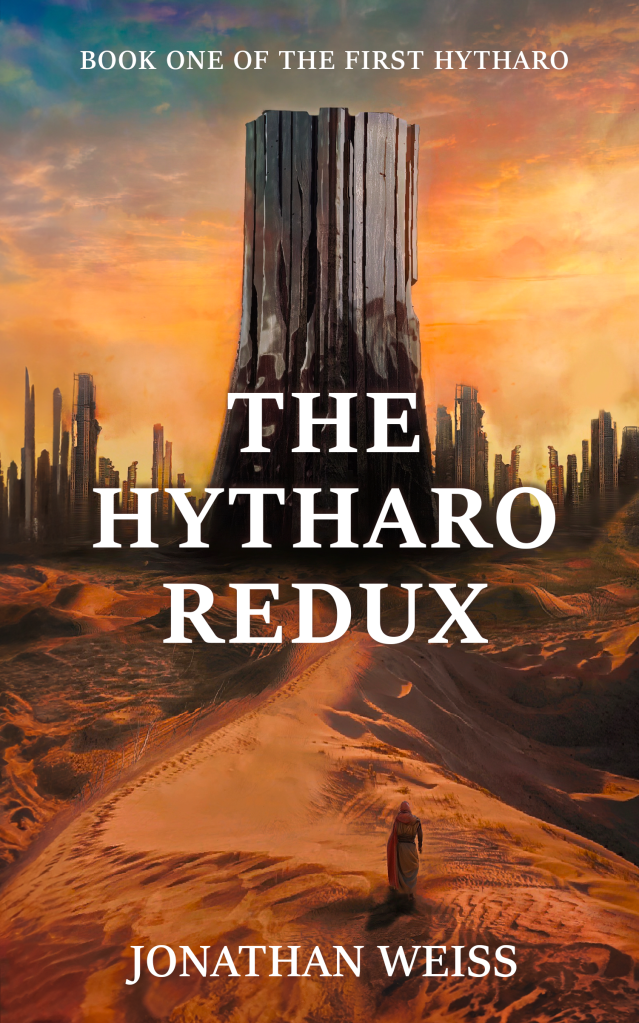
Lost among the dune-swept ruins of ancient glass towers, 14-year-old Spiric hunts for his stolen memories. Guided by the exiled scholar that found him, he embarks on a perilous journey across the Droughtlands to uncover his origins.
He’s told his red eyes mark him as a Hytharo, one of the long-extinct storm callers that sealed all water into the air itself before they were erased from history. In the thousand years since, thirst has been quenched simply by breathing, but that hasn’t stopped the surviving runic peoples from wanting water any less.
For without it, there’s no ink, no runes, no magic, and in the vast desert wastes of the Droughtlands, magic means power.
To Spiric, the mantra is eerily familiar.
Word of his presence ripples across the Droughtlands and pressure mounts on him to reverse the Hytharo’s final, sacrificial act. It’s only as his memories begin to return that he realises the true reason his people were wiped out.
With the fragments of Spiric’s memories growing bloodier and more desperate, he must determine whether carrying out his supposed fate will cause history to repeat, or if he can forge a new destiny, both for himself and the Droughtlands.
Print Book ISBN: 9781800817357 Thriller BIC: FF, 5HC 26 October 2023 £10.99 224 pp Hardback B format 198mm x 129mm World ex USA,Can eBook ISBN: 9781800817425
DESCRIPTION
THE CAST OF SUNDAY TIMES BESTSELLING THE APPEAL RETURN FOR A FESTIVE MURDER MYSTERY
One dead Santa. A town full of suspects. Will you discover the truth? Christmas in Lower Lockwood, and the Fairway Players are busy rehearsing their festive pantomime, Jack and the Beanstalk, to raise money for the church roof appeal. But despite the season, goodwill is distinctly lacking amongst the amateur dramatics enthusiasts. Sarah-Jane is fending off threats to her new position as Chair, the fibreglass beanstalk might be full of asbestos, and a someone is intent on ruining the panto even before the curtain goes up.
Of course there’s also the matter of the dead body. Who could possibly have had the victim on their naughty list?
Join lawyers Femi and Charlotte as they read the round robins, examine the emails and pore over the police transcripts. Will the show go on?
PUBLICATION DATE: 12th OCTOBER 2023 HARDBACK ORIGINAL | £16.99 | ORENDA BOOKS
Description
Henri Koskinen, intrepid insurance mathematician and adventure park entrepreneur, firmly believes in the power of common sense and order. That is until he moves in with painter Laura Helanto and her daughter…
As Henri realises he has inadvertently become part of a group of local dads, a competing adventure park is seeking to expand their operations, not always sticking to the law in the process…
Is it possible to combine the increasingly dangerous world of the adventure-park business with the unpredictability of life in a blended family? At first glance, the two appear to have only one thing in common: neither deals particularly well with a mounting body count.
In order to solve this seemingly impossible conundrum, Henri is forced to step far beyond the mathematical precision of his comfort zone … and the stakes have never been higher…