
Blog tour calendar: Lovebroken, by Finley de Witt
Book blogger, Autistic, Probably a Dragon

It was meant to be an in and out mission…
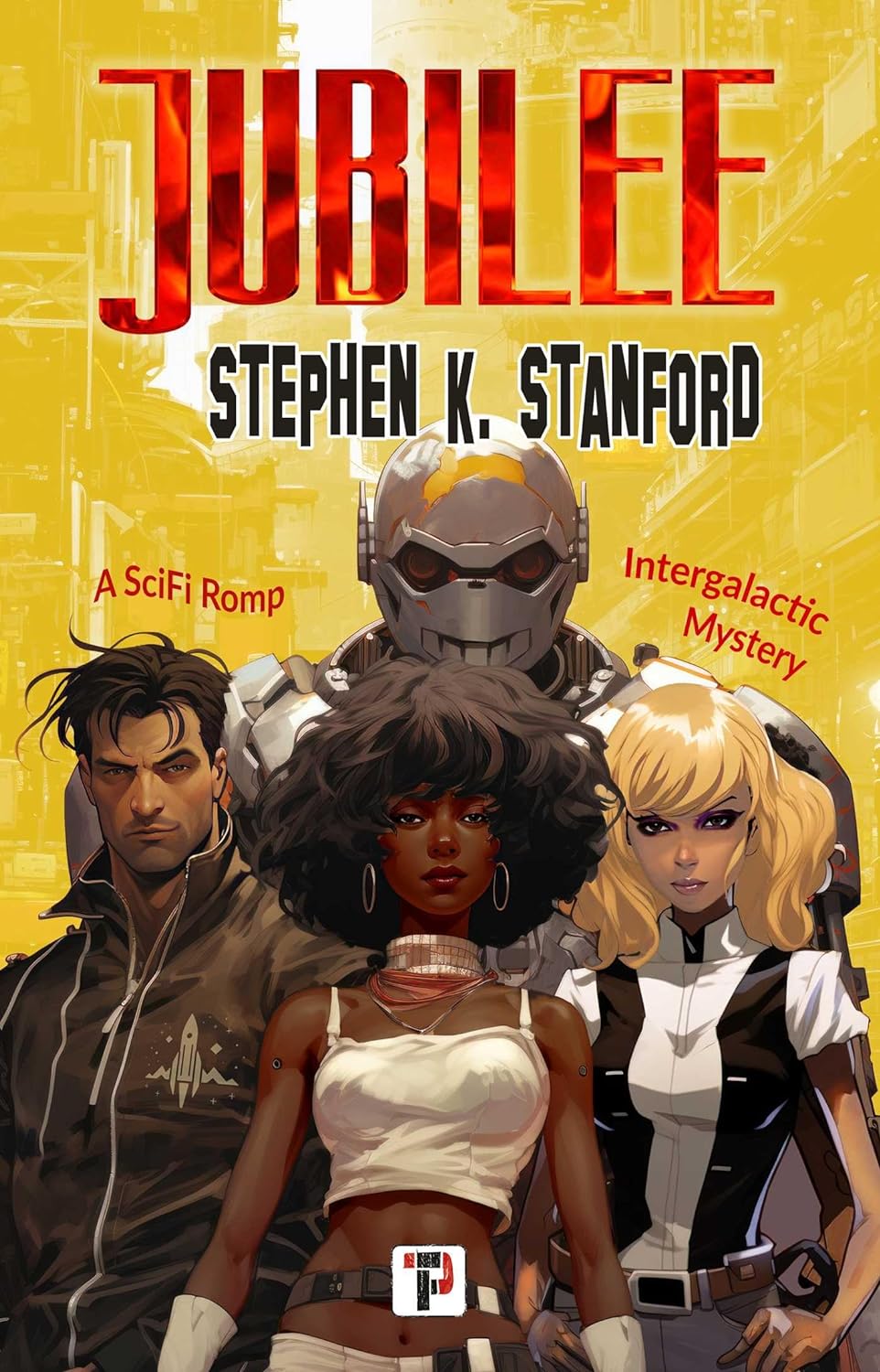
Jubilee is a lawless, artificial world existing within its own parallel universe; a seething cesspool of vice ruled by an eccentric AI.
So they say.
Detectives Col and Danee are sent to Jubilee on a hastily organised mission
to recover the body of a leading conservative politician (someone it seems,
has been a naughty boy). But the corpse has been switched and the
imperilled partners are drawn together. They might be falling in love, or they might be saving the galaxy– either way the authorities will not be pleased.
FLAME TREE PRESS is the imprint of long-standing Independent Flame Tree
Publishing, dedicated to full-length original fiction in the horror and
suspense, science fiction and fantasy. The list brings together fantastic new
authors and the more established; the award winners, and exciting, original
voices. Learn more about Flame Tree Press at http://www.flametreepress.com and
connect on social media @FlameTreePress

Hello all,
I’ve been thinking about this for a while. I don’t like to make people pay for my work, but at the same time, I’m disabled, I can only work a few hours a week and the exhaustion is interfering with my ability to write. I want to give myself an incentive to write when I feel well enough. If I have paying subscribers, I have to write!
I may have mentioned the Space Dragon story I’ve been working on for a couple of years. The plan is to share a chapter a month for paying subscribers until I’ve written it all. You won’t be getting the first draft, since I write that by hand, but you’ll get the edited version. There will probably be further edits in future before I release it as a book. I might also share some of my short stories as paid subscriber posts.
What do you think?
Let me share a few paragraphs with you and if you want the rest, please feel free to join the paid subscription.
Update 22/03/2025
No one wanted paid subscriptions, so I’ve unlocked this chapter and any others that I’ve posted.
Continue reading “Introducing ‘Maria and the space-dragons investigations’ – a draft novella”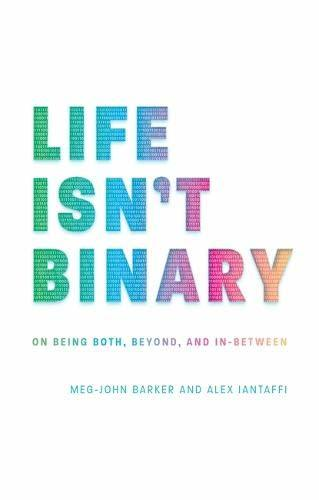
Description
Challenging society’s rigid and binary ways of thinking, this original work shows the limitations that binary thinking has regarding our relationships, wellbeing, sense of identity, and more. Explaining how we can think and act in a less rigid manner, this fascinating book shows how life isn’t binary.
My Review
This book starts with the obvious understanding of ‘non-binary’ in discussing sexuality and gender, and then goes on to discuss non-binary approaches to relationships, bodies, emotions, and thinking. What this really means is that people tend to think in either/or ways, yes/no, black/white, etc. but the authors recommend more and/both thinking about life.
For someone who is non-binary it is an interesting, yet obvious concept. Although I’m autistic and we’re often accused of black and white thinking, I’ve always wanted to ask why? and my conception of conflict as the stories people tell themselves not meshing completely, already allows me to view reality in a way that includes what the authors refer to as ‘multiversal’. The authors use a therapist and Buddhist way of putting it, but it’s the same thing. Our stories are always changing, we’re always in the process of becoming, not completed, not finalised. And we have many stories, depending on who we’re interacting with.
I found this book fairly interesting. I got through the first four chapters in record time, but the last two chapters seemed to drag a bit. It was mostly the last chapter. I found it a bit woo heavy, especially the ‘make an alter to yourself’ reflection point. I understand the authors are interested in Buddhism, and work as therapists, so it’s understandable. It just doesn’t work for me.
It’s a good introduction to non-binary genders and unconventional relationships.

It started with a lie…
Married couple Karin and Kai are looking for a pleasant escape from their busy lives, and reluctantly accept an offer to stay in a luxurious holiday home in the Norwegian fjords.
Instead of finding a relaxing retreat, however, their trip becomes a reminder of everything lacking in their own lives, and in a less-than-friendly meeting with their new neighbours, Karin tells a little white lie…
Against the backdrop of the glistening water and within the claustrophobic walls of the ultra-modern house, Karin’s insecurities blossom, and her lie grows ever bigger, entangling her and her husband in a nightmare spiral of deceits with absolutely no means of escape…
Continue reading “Extract Post: THE GUESTS, by AGNES RAVATN, TRANSLATED BY ROSIE HEDGER”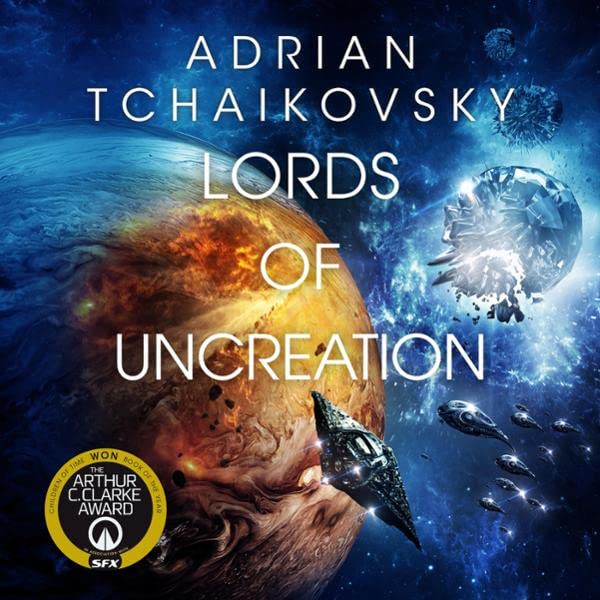
From Adrian Tchaikovsky, author of Children of Time and winner of the Arthur C. Clarke Award, Lords of Uncreation is the final high-octane instalment in the Final Architecture space opera trilogy.
He’s found a way to end their war, but will humanity survive to see it?
Idris Telemmier has uncovered a secret that changes everything – the Architects’ greatest weakness. A shadowy Cartel scrambles to turn his discovery into a weapon against these alien destroyers of worlds. But between them and victory stands self-interest. The galaxy’s great powers would rather pursue their own agendas than stand together against this shared terror.
Human and inhuman interests wrestle to control Idris’ discovery, as the galaxy erupts into a mutually destructive and self-defeating war. The other great obstacle to striking against their alien threat is Idris himself. He knows that the Architects, despite their power, are merely tools of a higher intelligence.
Deep within unspace, where time moves differently, and reality isn’t quite what it seems, their masters are the true threat. Masters who are just becoming aware of humanity’s daring – and taking steps to exterminate this annoyance forever.
My Review
I’ve read or listened to quite a few of Adrian Tchaikovsky’s books in the last few years. I’m reading one currently, and I’ve just finished listening to this book. I’ve met Adrian a couple of times at FantasyCon; he’s from Lincolnshire and got his honorary Doctorate in January 2019, at the same ceremony I received my Masters at Lincoln. He’s a bit of a weirdo, but not a bad one. His son is autistic (some people I know who grew up with Mr Tchaikovsky have speculated that he’s ADHD but I don’t know), and he tries to include neurodivergent characters in his more recent books. I particularly enjoyed the crows in Children of Memory, who are ADHD and Autistic. I’m considering getting paperback copies to add to the Little Neurodivergent Library at work.
In the The Final Architecture books, the ‘ints’ are neurodivergent – most have deliberately damaged brains that allows them to process the world in a way entirely differently to the majority of the population. Some are naturals – like the first ‘int’, Saint Zavienne, and some of the Partheni new class who have the ‘right’ genetics for sensitivity to unspace travel, but most have an acquire brain injury that makes the neurodivergent. They are significantly disabled by their brains, and Idris is one of the most disabled. He’s also the oldest, one of the original class, almost a hundred years old; never aging, never sleeping, always anxious, always highly stimulated. His obsession with finding the Masters, the ones driving the Architects to destroy sentient life in the universe, pushes him close to death, multiple times. Usually he only survives because of some piece of tech or emergency procedures taken by his friends and occasionally his enemies.
I found Idris to be a bit of a wet blanket, but he admits to being a weak, ‘little’, man. He’s small and physically weak from his early years of deprivation, his long life of hard labour fighting the Architects and travelling in the unreal. He has a strong spirit and his frustration with people who won’t listen and who won’t consider the implications of their actions resonates. He is opposed to genocide, which is a perfectly reasonable position to hold, and he seeks the first cause. I can agree with that position. I don’t think we’ll find an intergalactic species desperate to recreate the conditions of their original universe at the centre of our problems however.
Idris is the driver of the mission, but the driver of the plot is Olli, who along with Kitt the Hanni are the remaining crew of the Vulture God, while everyone else is on the Eye buggering about in unspace. Olli, being a suspicious bint, doesn’t trust anyone, particularly the ‘parthos’ – the women of the Partheny. And she’s right to be suspicious, as she uncovers a breakaway group plotting a coup, and helping the arc-ship building cabal. A pointless war breaks out between Hu and the Partheny. Olli and Kitt take the ship, and an Ogdru (an aquatic species that can navigate unspace) called Junior out of it and try to save everyone.
Eventually, they end up saving the universe. Olli gains various items from the Hegemony, after she becomes heir to ‘The Razor and The Scythe’, as Unspeakable, head of a crime syndicate, and by the end of the novel, head of her own nation. Olli is my favourite character, and I really want a novel about her adventures as Unspeakable. Her attitude of ‘fuck it’, her willingness to try whatever she needs to do to survive and to help her friends survive, and her magic legs from the Hegemony, make her an engaging, fun character.
The story is complicated and has several parts. First the mission on the Eye, then the war, then the rescue, and finally back to the mission. The narrative uses multiple voices to tell the story – a limited 3rd person omniscience – and there is some overlap between the chapters as the same events are told by different characters and then taken forward. Since events happen across hundreds of thousands of kilometres of space, this is quite helpful. I enjoyed seeing events from multiple perspectives.
The narrator, Sophie Aldred, is very good. She gives each character their own personality. She has really good pacing and inflection, although some of her pronunciations are wrong. I enjoyed listening to this audiobook. I found myself looking forward to getting back to it while also finding ways to stretch it out because I didn’t want the story to end.
If you’ve enjoyed Adrian Tchaikovsky’s other books, you’ll probably enjoy this one. The man publishes two or three books a year, so you’ll probably always have something to read/listen to. He’s really good at space opera with relatable human (and nom-human) characters.

They’re the housemates from Hell…
When her disastrous Australian love affair ends, Lou O’Dowd heads to Edinburgh for a fresh start, moving in with her cousin, and preparing for the only job she can find … working at a halfway house for very high-risk offenders.
Two killers, a celebrity paedophile and a paranoid coke dealer – all out on parole and all sharing their outwardly elegant Edinburgh townhouse with rookie night-worker Lou…
And instead of finding some meaning and purpose to her life, she finds herself trapped in a terrifying game of cat and mouse where she stands to lose everything – including her life.
Slick, darkly funny and nerve-janglingly tense, Halfway House is both a breath-taking thriller and an unapologetic reminder never to corner a desperate woman…
Continue reading “Extract Post: Halfway House by Helen Fitzgerald”
Two elven sisters become imprisoned in the hidden world of the fae where danger, and love, lies in wait. Faebound is the first book in an enchanting new trilogy from the internationally bestselling author of The Final Strife.
A thousand years ago, the world held three fae, elves, and humans. But now the fae and humans exist only in myth and legend, survived by the elves who are trapped in an endless war over the remaining lands.
Yeeran is a colonel in the elven army and has known nothing but a life of violence and hardship. Her sister, Lettle, is a diviner whose magic promises a different future for her and her sister, but the prophecies have yet come to pass.
When a fatal mistake leads to Yeeran’s exile from the Elven Lands, Lettle, fearful for her sister’s life, follows her into the uncharted territory beyond their borders. In the wilderness the sisters encounter the largest obeah they have ever seen. Part leopard, part stag, the obeah’s magic is harnessed to make weapons for the elven war. It is during this hunt that they are confronted with the a group of fae who take them captive. Imprisoned in a new land, they must navigate the politics of the fae court all while planning their escape.
Now Yeeran and Lettle are fighting a different kind of between their loyalty to their elven homeland and the intoxicating world of the fae, between what duty decrees is right, and what their hearts tell them they need.
My Review
Alright, one last review for the day and then I’m off to bed. I’ve just read about 300 hundred of the 395 pages this evening. I read the rest last month. I’ve been busy. Now I have to wait for the next one! And it promises to be so good!
I don’t normally like romantic fantasy, even though it seems to be a really popular genre at the moment. I prefer fantasy with a romantic sub-sub-sub plot. Fantasy that could stand without the romantic elements. There should be more that just lust and romantic love moving the plot forward. Nor should sex be substituted for actual character development.
But.
I like this one. The characters are fun, there’s battles, murder, prophesy, finding and losing family, betrayal, talking animals…all the fun stuff. The plot does rely a bit on the enemies to lovers trope, but that’s a romantasy staple and in the context it actually works. El-Arifi doesn’t use sex as a substitute for character development, although there is some in there. On the beach, of all places.
The main characters are Yeeran and Lettle, a colonel in the Waning army and a Seer. They are sisters in their late thirties and twenties, respectively. That makes a nice change. Main characters that aren’t children. They’ve had a hard life. Yeeran chose to join the army and fight in the Forever War, while Lettle was too young to leave, and had to stay with their father. After poisoning him as dementia took control, Lettle seeks solace in an old temple, and meets her mentor, a Seer, who takes her to their capital and trains her in divination. Yeeran rises to become the youngest general in the Waning army, while Lettle becomes a powerful diviner, although divination, the gift to elves from the moon god is increasingly ignored and disparaged.
Then Yeeran makes a battlefield mistake that costs hundreds of lives. Sent into exile, Yeeran seeks out a way to win back favour with her chieftain/lover. Lettle, and Yeeran’s Captain, Rayan, follow her into exile, through the neighbouring Crescent and meet up as Yeeran is hunting an obeah.
Then things turn nasty. Because the obeah is faebound to a fae prince, who will die when the obeah does, and a fae princess witnesses the death. There is a nasty fight and Yeeran is condemned to death. But first the three elves must be marched through the wasteland to the underground home/prison of the fae.
Just when it looks like everyone is going to die, Yeeran bonds with an obeah herself. This changes everything. The fae won’t kill an obeah, and killing Yeeran would kill an obeah. This gives Yeeran, Lettle and Rayan a few months respite to find a way to escape. Something is happening outside the fae lands, and inside there is dissension in the ranks. The arrival of three elves changes the balance and they will all learn something about themselves and the world.
I’ll admit, my favourite character is Pila, the obeah bonded to Yeeran. She’s a sarcastic bint and I love her. The elves and fae are okay, I suppose, but I want more obeah adventures! I’m joking, although Pila is my favourite, I like the way the characters are developing and the push-pull of duty and attraction. Lettle sees most things more clearly than her sister, but Yeeran is too bound up in her training to accept that Lettle might be right. The tension between the two sister, and the tension between Yeeran and Furi, drive the story forward. These tensions represent the tension between two elvish worldviews and the competing elvish and fae worldviews, that need to be reconciled for them the move forward.
Furi is furious most of the time, be as the reader gets to know her through Yeeran’s eyes, we discover that the anger is a cover for grief, pain and fear. She’s trapped in Mosima, trapped in her duty to people and family, her future is determined for her by a curse, and she has no way out. She turns this outward towards elves in general and Yeeran in particular. Yet, it’s the arrival of Yeeran, Lettle, and Rayan that will eventually free her.
Also, it’s very, very queer. As in the societies are queer normative. And I love to see it.
That’s the big reveal at the end. Which I’m not going to spoil. You all need to go out and get this book. The standard edition will be published in a week or so, and I think I have a copy on order with Waterstones. (Look, we all know I’m a completist, I can’t help myself. I just found out there’s a FairyLoot exclusive edition and I can’t get it! It’s very frustrating!)
 Everything Is Better With Dragons