Alright, I’m back with more. It took less time than I thought.
Chapter 15, part 2
“Mrrh-wAa, what are you doing?” The new comer sounded desperate, “The Elders told you not to contact the aliens, Supai said it was dangerous!”
“Prrt-hai! Are you following me? They’re from igassss, like Supai. They’re looking for Supai!” Mrrh-wAa hurried their words out, “I told you it would be fine, you fussing will just worry the brood.”
“Yes, yes, the brood worries and the Elders were very specific; you are not to talk to the aliens.”
Sorry it’s taken so long for me to update the story, but I’ve been struggling with my brain weasels for months and I have been struggling to write. I’m back now! I’ve almost finished writing the first draft of this novella and I’ve started writing a novel and a short story. I’ve had some work accepted by a local LGBTQIA+ zine, and I’ve submitted a short story to a competition. I will try to update with part two in the next few days.
Chapter 15 – Maria and Sahrai meet the local sentient aliens
“Now then, McClintock, been a while. Not going up top this time ‘round?”
The man, Joshua Dalton, accosted Maria and Sahrai as the track towards the crossroads, several days after their adventures in the flyer. He stood in the road, blocking their path.
“Dalton.” Sahrai nodded sharply at the man and ushered Maria around the man.
Dalton joined them, uninvited, walking beside Sahrai, grinning at thev discomfort of his companions.
Books can change lives. Magic books can change everything.
In a tiny, miserable farm on the edge of the tiny, miserable village of East Grasby, Isabella Nagg is trying to get on with her equally tiny and miserable existence. Dividing her time between enduring her feckless husband, inadequately caring for the farm’s strange collection of animals, cooking up ‘scrunge’, and crooning over her treasured pot of basil, Isabella can’t help but think that there might be something more to life. So, while she’s initially aghast when Mr. Nagg comes home with a spell book purloined from the local wizard, she soon starts to think: what harm could a little magic do?
As Isabella embarks on a journey of self-discovery with a grouchy cat-like companion, Darkshire’s imagination runs wild, plunging readers into a delightfully deranged world full of enchantment, folklore, and an entrepreneurial villain running a magical Ponzi scheme.
My Review
I found out about this book on Saturday from the Hodderscape Instagram feed and ordered it straight away from the local Waterstones. I picked it up after I went to The Festival of the Sea, got home, and read it in a single sitting.
I was promised Pratchettian humour.
There were footnotes. The footnotes were funny. There was a lot of folklore drawn on as well as invented. Which does smell of Discworld, but doesn’t quite scratch the itch. I did not get my Pratchettian story.
The story is of Isabella Nagg realising she doesn’t have to be a farmer’s wife after reading a magic book (stolen from the local wizard by her useless husband), fighting goblins and grifters, and dealing with past events as they come home to roost. There is a mysteriously disappearing wizard and a mysteriously appearing pony, a talking donkey, a grifter looking to set up a ‘new goblin market’ and the eponymous pot of basil.
It was quite, quite silly and I enjoyed the story immensely, even if it did at first feel contrived. Once I got into it, I could see the charm in this cosy fantasy. The social commentary and observations of life in small rural villages was pointed and entertaining, while the criticisms of unequal marriages was sharp.
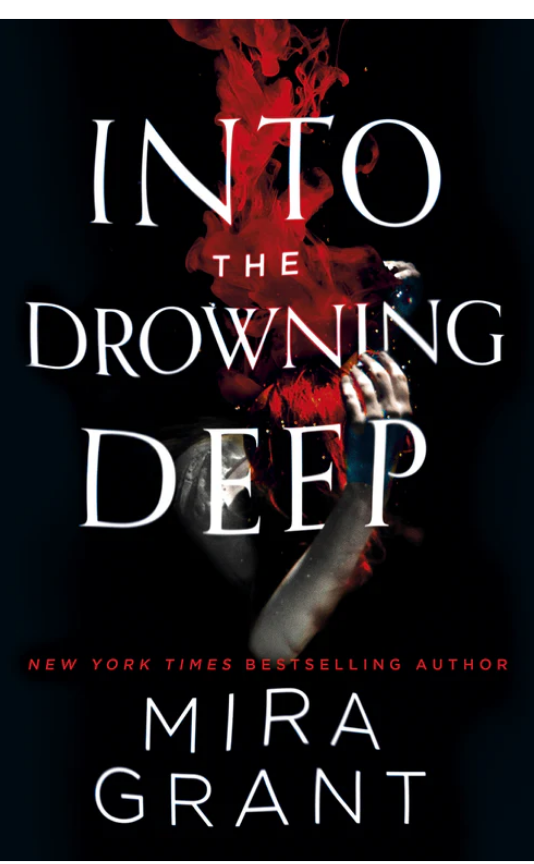
‘Times like these you wish you had something to pray to’
Idolfire is an epic sapphic fantasy inspired by the fall of Rome from the author of the Frontier and Floating Hotel.
ON ONE SIDE OF THE WORLD, Aleya Ana-Ulai is desperate for a chance. Her family have written her off as a mistake, but she’s determined to prove every last one of them wrong.
ON THE OTHER, Kirby of Wall’s End is searching for redemption. An ancient curse tore her life apart, but to fix it, she’ll have to leave everything behind.
Fate sets them both on the path to Nivela, a city once poised to conquer the world with the power of a thousand stolen gods. Now the gates are closed and the old magic slumbers. Dead—or waiting for a spark to light it anew . . .
My Review
I listened to this over several days, usually while walking to the pool and back. I’ve also got an special edition of the hardback on the shelves. I have all of Grace Curtis’ books and I’ve noticed a theme running through them. All of them contain people on a journey who learn about themselves in the process of completing their journey.
In this book we find Kirby who discovers that the world is bigger than she thought it was, and that there are more options than marrying a local boy. Aleya discovers an internal source of strength to make the changes she knows her city of Ash needs. Nylo learns to stop being a bigoted prat, just before he dies in battle.
The world building draws heavily on the ancient world and the author’s note does explain their inspiration. Kirby feels like she’s from the north east of England (helped by the accent the narrator has), while Nylo screams of Sparta, and Aleya is from somewhere in Mesopotamia. The landscape is vividly described, as the group sail and walk across the world from their various homes to Nivela as they try to complete their individual quests. The land and seascapes are an important part of the plot, which adds to the tension (especially that undersea tunnel and the wastelands around Nivela!) in what is a pretty standard quest story.
The magical system, idolfire, is powered by worship and limited in scope. It drains the power source and can harm the person using it. Magic without limits is a deus ex machina. Aleya’s inability to use the idolfire at difficult moments brings tension to the plot. It also provides the odd last desperate attempt to survive.
I enjoyed the characters of Kirby and Aleya, while Nylo got on my nerves. He’s a tit, who’s perspective is egregiously clouded by his prejudices. Both Kirby and Aleya have their prejudices, but it doesn’t cloud their perspective as much as his does. There were other minor characters that I found entertaining, like the little seer who takes Kirby to see a sheep’s skull after calling Aleya a liar.
Overall, a good quest story set in a vaguely familiar world that isn’t pseudo-medieval north western Europe.
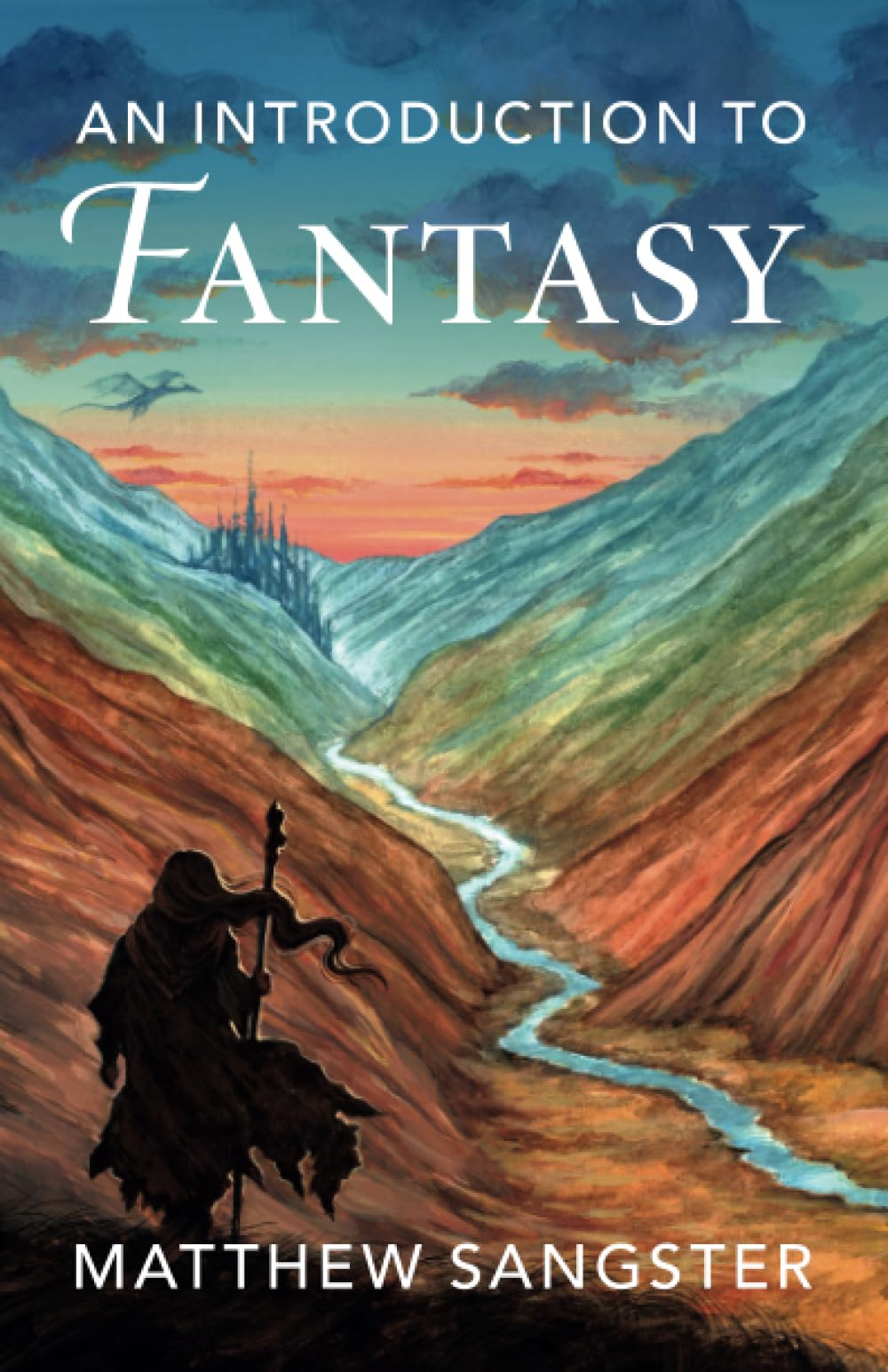
Format: 469 pages, Paperback Published: September 7, 2023 by Cambridge University Press ISBN: 9781009429948
Providing an engaging and accessible introduction to the Fantasy genre in literature, media and culture, this incisive volume explores why Fantasy matters in the context of its unique affordances, its disparate pasts and its extraordinary current flourishing. It pays especial attention to Fantasy’s engagements with histories and traditions, its manifestations across media and its dynamic communities.
Matthew Sangster covers works ancient and modern; well-known and obscure; and ranging in scale from brief poems and stories to sprawling transmedia franchises. Chapters explore the roles Fantasy plays in negotiating the beliefs we live by; the iterative processes through which fantasies build, develop and question; the root traditions that inform and underpin modern Fantasy; how Fantasy interrogates the preconceptions of realism and Enlightenment totalisations; the practices, politics and aesthetics of world-building; and the importance of Fantasy communities for maintaining the field as a diverse and ever-changing commons.
Literary awards:
Mythopoeic Scholarship Award for Myth and Fantasy Studies (2024)
My Review
I’ve been working my way through this book since last October, around blog tours, getting slightly too obsessed with YouTube , and a lot of crochet. I finished the last 40 pages this evening and now I need to tell you all about it. Matthew Sangster is a product of Glasgow University’s Centre for Fantasy and the Fantastic, and the access to many fantasy novels and academic works show in the text. Sangster mentions works by some of the most well-known in fantasy, such as Le Guin and Tolkein, and some more unexpected authors, especially those from earlier centuries. He draws out six important points about fantasy, over the chapters of this books and they form his core arguments:
Fantasy arises from figurative language
Iteration is a defining technique – new stories build on old in new ways
Contemporary fantasy builds on some of the oldest forms
Fantasy exists in conversation with realism
Worldbuilding is both the prevailing metaphor of modern fantasy and used to develop plots and characters
Fantasy is a form practised in community rather than one by unique geniuses.
I had to read the ‘Envoi’ chapter to get that. Sangster helpfully lists these points for the reader. It certainly helps with the summary. He does try to be accessible throughout the book, and uses a lot of examples to make his points, referencing very well-known authors, TTRPG series, video games, and film franchises in the process. It was heavy going at times, but that might be my lack of formal education in Literature at University Level. My M.A. is in Creative Writing, not Literature, after all.
Sangster raises some good points, especially about the tendency of ‘literary’ culture to consider ‘genre’ fiction as lesser, as the mode of storytelling is not ‘realistic’ and therefore can’t possibly impact readers. Fantasy, Sangster argues, explores the real world using the fantastical as a foil, a universalising storytelling mode that draws on cultural language. Fantasy can tell stories in ways that resonate with people far more effectively than straight up realism. It digs down into the root, builds on older foundations and finds new ways to explore ancient concerns.
I certainly find fantasy a useful vehicle for understanding the world, particularly in the work of Terry Pratchett. Fantasy communities, whether specific fandoms, organisations for writers, or online groups (such as the BFS Discord – Join the BFS, and come to our Discord, we have quiz nights and shadow daddies!), work in dialogue with the stories and their creators. New worlds spin off from the original, and people have a shared language to communicate with, across time and culture (see: Vimes’ Boots Theory of Economics).
I found Sangster’s work thoughtful and interesting, although it is very much an academic text so possibly not something a casual reader might go for. Useful for those interested in SFFH in an academic setting e.g., if you’re doing your M.A. in Fantasy and Sci-Fi literature or as a basis for a Doctorate in the field. Yes, those do exist, and yes, they’re a bit serious. (Again, see Glasgow University).
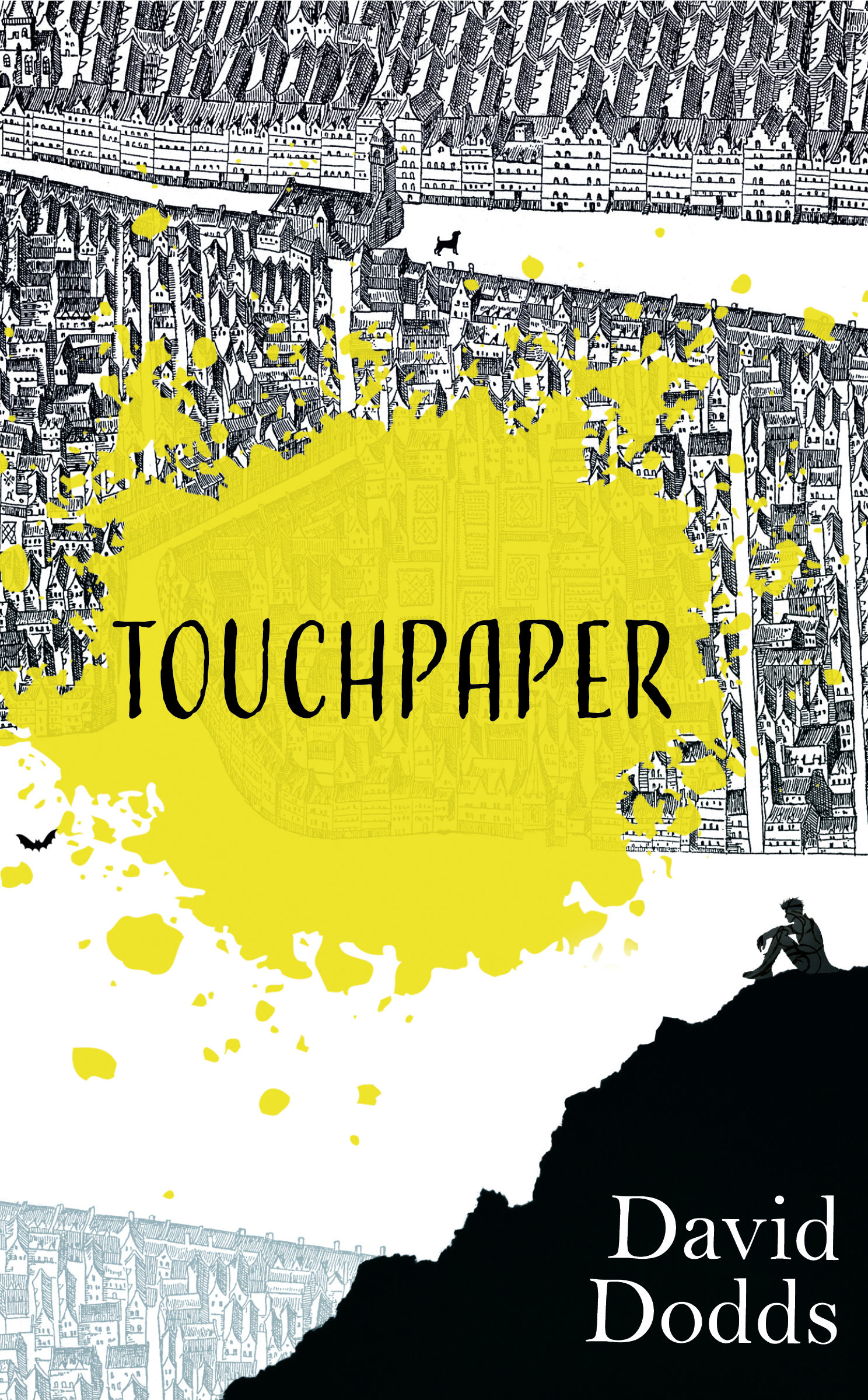
‘A bloodcap, an angelus and a Jack Russell terrier. They’re all I had by me to face mortal combat with the Queen of the Ælves. I’d be dead in minutes…’
The historic streets of Edinburgh hide a parallel realm of shadowy killers, vicious ælves and deranged shades. All that stands between them and the unsuspecting populace are a daemon called Archer and the group of angelii he’s feuding with.
Drew Macleod is caught in the middle. Someone, somewhere is hunting him. But why? Delving deeper into this parallel realm, Drew finds allies in a feisty herbalist, an ancient creature in disguise and an old clock-maker – but are any of them really who they seem to be?
Touchpaper takes us on an exciting journey in the footsteps of Neverwhere and Rivers of London. This original and imaginative story lets a quirky cast of characters lead us into a hidden and dangerous world. The contemporary setting and the richness of the characters holds our attention in a fast-paced and at times humorous read, full of plot twists and quirky details.
Format: 508 pages, Paperback Published: July 12, 2022 by Angry Robot ISBN: 9780857669827
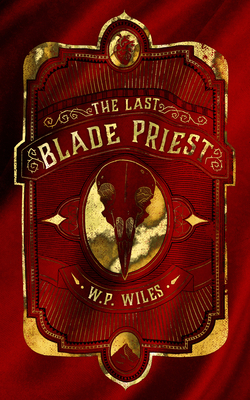
Inar is Master Builder for the Kingdom of Mishig-Tenh. Life is hard after the Kingdom lost the war against the League of Free Cities. Doubly so since his father betrayed the King and paid the ultimate price. And now the King’s terrifying chancellor and torturer in chief has arrived and instructed Inar to go and work for the League. And to spy for him. And any builder knows you don’t put yourself between a rock and a hard place.
Far away Anton, Blade Priest for Craithe, the God Mountain, is about to be caught up in a vicious internal war that will tear his religion apart. Chosen from infancy to conduct human sacrifice, he is secretly relieved that the practice has been abruptly stopped. But an ancient enemy has returned, an occult conspiracy is unfolding, and he will struggle to keep his hands clean in a world engulfed by bloodshed.
In a series of constantly surprising twists and turns that take the reader through a vividly imagined and original world full of familiar tensions and surprising perspectives on old tropes, Inar and Anton find that others in their story may have more influence on their lives, on the future of the League and on their whole world than they, or the reader imagined.
My Review
I picked up this book at FantasyCon last year, although more precisely the author gave me a copy after the final panel about the essentials an adventurer needs and I asked why no one ever took a map and compass? I think it’s being raised by a former Scout, and being a Guide myself from a young age, I just naturally just consider maps, compasses and spare change for a phone, as essentials for adventuring off the beaten track. These days of course, finding a pay phone is hard, so you should take your phone charger and a spare battery pack in your bag. If you can get a signal, you can get help!
Okay, so back to the book.
Our first main character is Inar, a master builder from the recently conquered kingdom of Mishig-Tenh. The League want him to help them find a way into the Hidden Kingdom. And they won’t take no for an answer. Since his father and brother were executed as traitors, and Inar will go the same way if he doesn’t spy for the remaining leaders of the kingdom, he agrees. He has to lead a team of explorers through the mountains to meet representatives from the Mountain God. Things go very wrong, and secrets are revealed that probably should have been kept hidden, including a girl, called Duna, who can bring down mountains.
Our second main character is Anton, one of the last Blade Priests, vertzan of the God Mountain, Craithe. At nineteen, Anton has only one friend in the monastery-fortress, his sister-priestess, Elecy. They have been trained from a young age to perform the human sacrifices required by the demi-gods on the Mountain, until the demi-gods (giant vultures, called Guardians) decided that they don’t want human sacrifice anymore. This has caused a rift in the faith, between the traditionalists and the progressives. Anton is chosen to be the successor to the altzan-al (high priest/pope?) until he’s set up for the murder of the altzan-al. Rescued by Elecy and a young scout, he sets out to find allies in the outside world, while Elecy stays behind to keep an eye on the new regime.
There’s a war and invasions, gods die. Things explode. Duna gets high and goes a little bit battle-mad. At the end, the world has changed for everyone involved, while Duna and Elecy meet up and head out into the world, probably causing mayhem in the future. I can’t wait to read the second book, which isn’t out for another year.
Mad elves, high on mushrooms, kidnap the main characters and their parties. It’s a unique idea – elves are humans who take a mushroom that makes them feel immortal, and not feel pain as their ears and face are cut. I
One of the people in the League party is a surveyor, and Inar is amazed by the idea of accurate surveys. I love the idea of introducing new ideas into a world and seeing how they play out with the different cultures. Inar doesn’t understand why they were traveling so slowly, although a reader would when the mentions of notes and poles, sighting on mountains, that sort of thing.
The League is obviously an empire in waiting, despite the rhetoric of freedom, logic and science. Some of the characters from the League have good intentions, but some are very obviously looking to build a legacy. The church of the God Mountain have, or had, an empire and are shrinking, while some factions are looking to accept the change of status, others want to rebuild it. They are mirrors of each other.
I enjoyed the twist at the end, as Anton realises the Guardian’s prophecy is not about him. He’s a bit slow on the uptake; an attentive reader would have picked that up fairly quickly.
The book is chunky at 508 pages, but the story flies along; the world is complex, the characters are fascinating, and the plot kept me engaged.
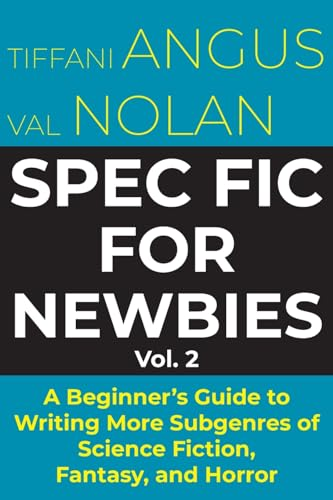
Beam aboard your own Science Fiction, Fantasy, and Horror classroom with the next volume of the BSFA-shortlisted writing-guide series!
Join Tiffani Angus (Ph.D.) and Val Nolan (Ph.D.) for a whirlwind introduction to the storytelling basics of 30 more subgenres and major tropes from across the limitless realms of Speculative Fiction.
Learn about Space Opera, Folk Horror, Climate Fiction, Werewolves, Astronauts, Mythic Fantasy, Goblin Markets, Dragons, and many more with deep dives into each subgenre’s history and development, spotter’s guides to typical examples, pitfalls to watch out for in your own writing, and activities to help you get started! All derived from a combined two decades of university-level practices and experience!
Spec Fic for Newbies breaks genres into bite-sized pieces for students or for any budding writer. It offers a welcoming introduction to how writers, filmmakers, and other creatives can begin to explore the infinite potential of Science Fiction, Fantasy, and Horror to create new stories beyond the boundaries of the ordinary.
This is not another dusty rulebook. This is a portal to endless other worlds!



 Everything Is Better With Dragons