When her cousin gets kidnapped by a dastardly trickster, Luzia is forced to sell herself in servitude to the Eoi in exchange for his life. But the terms of the deal turn out to be much more complicated than she ever imagined…
Luzia N.E. Drainway never really thought too much about the Astrosi. They lurk above and below Bastion City – a giant multileveled megalopolis she calls her home – and they tend to keep to themselves. On the rare occasions they use their magics to meddle with human affairs, most people with an ounce of sense steer clear of whichever unfortunate soul happens to be their victim. Luzia is far too dedicated to repairing and maintaining the frequently-damaged Bastion to pay them much attention, and prefers to ignore the Astrosi just like everyone else.
That disregard gets blown out of the water when a rogue Astrosi and nefarious trickster named Carrion kidnaps her nephew and sells him to the Eoi, one of the Astrosi courts.
With no other options to save her nephew, Luzia trades her life for his and finds herself in service to the Eoi. Unfortunately for her, Astrosi logic is acrobatic in ways even the most devious human mind can barely comprehend. It’s not until the deal is struck that she realizes she’s trapped in the most abstruse verbal contract imaginable. She is essentially conscripted into their ranks, and her devotion to her city becomes stretched to breaking point by her new masters’ orders.
As she struggles under this weight, she begins to uncover the secrets of the Astrosi people – the internal battles for power between the two kingdoms, the never-ending conflict between them, the trickster Carrion who somehow bridges that gap, and the very nature of the Bastion itself.
What Would You Do To Discover Your Heart’s Desire?
Greton of Willow is in a spot of bother. Caught in the act while escorting a family of elves to safety, Greton flees for greener pastures with only his scant magic and brilliant mind to his name.
And a question. The question.
‘What is your heart’s desire?’
A life-long outsider, Greton sets out to uncover what lies at the centre of his heart. Is it adopting a tawny owl? Owning his very own map shop? Forging a found family with others as similarly scorned as himself? The possibilities are endless. Determined to put his marvellous mind to the task, Greton discovers a way to reveal anyone’s heart’s desire, but not everyone’s longings are as pure as his…
Something odd is occurring in Greton’s new home of Barrow’s Hill, and, before long, the old man in search of a comfortable new life finds himself swept up in danger and mischief.
A heart-felt, cozy, neurodivergent adventure filled with found family and an elderly autistic hero searching for his place in the world, ‘Magic, Maps, and Mischief’ is a story built on love, friendship and acceptance, perfect for readers of ‘Legends and Lattes’, ‘The Teller of Small Fortunes’ and ‘Under The Whispering Door’.
I have an advanced copy of this book (from the author), and so far, I love it. Greton is delightful! Elderly, autistic, and asexual, he makes friends with elves, disabled owls, and sea captains as he searches for his hearts desire. I will be reviewing after publication, and I will be buying an official copy.
I hope David publishes a paperback copy eventually. It’s available on Kindle Unlimited from publication date, but you can also buy it for £2.99. For more about David, see his website. I have two different editions of his In Solitude’s Shadow, and will also be reviewing the latest edition as soon as I get a chance.
The cover design is gorgeous – Liz Delton is so talented! I’m going to have to talk to her about a cover design when I get my space dragon story finished.
From sci-fi visionary and acclaimed author Annalee Newitz comes Automatic Noodle, a cosy near-future novella about a crew of abandoned food service bots opening their very own restaurant.
While San Francisco rebuilds from the chaos of war, a group of food service bots in an abandoned ghost kitchen take over their own delivery app account. They rebrand as a neighborhood lunch spot and start producing some of the tastiest hand-pulled noodles in the city. But there’s just one problem. Someone―or something―is review bombing the restaurant’s feedback page with fake “bad service” reports. Can the bots find the culprit before their ratings plummet and destroy everything they created?
My Review
It’s 2064. California has fought a war of Independence from the United States, and has freed robots above a certain level of intelligence. Well, not really free, they can’t own property, reproduce, or have bank accounts. Their licenses can be bought and sold, tying them to contracts and companies that can take them apart for scrap or sell them on saddled with debt. So not free at all.
Staybehind is an ex-military robot, free from contract and working wherever it wants. It happened to be working as manager of a terrible fast food franchise when it was shut down. Hands, the chef bot, Sweetie the front desk bot, and Cayenne, a former search and rescue octobot turned gastronome who likes to taste and smell food, slowly wake up after Staybehind is alerted to an emergency – their store is flooding. Once they work out what’s going on, the group make the decision to run the store for themselves, if they can find a way around the laws. Cayenne is on that.
Together with a human called Robles and an automatic minivan called Sloan, the robots go into business for themselves selling noodles. After a great review they get very busy, but then another review outs them as robots and starts review bombing the food delivery app everyone uses. While Staybehind searches for the culprit and discovers they have an artistic streak, Cayenne and Sweetie come up with other plans.
It’s a novella. I’ve read it in less than 3 hours this afternoon. I’d planned to go swimming but my lungs decided otherwise, so I’ve spent the afternoon on the sofa reading. I’m going back to bed as soon as I’ve written this because I’m sick once again!
I’ve read Annalee Newitz’s books in the past and enjoyed them; the author always seems to find the right tone for the subject and the right themes for the times. This is the case with Automatic Noodle too, with themes of found family, community resilience, and post-war rebuilding. The robots are stand-ins for the groups currently demonised by the right in the U.S. (and the U.K. honestly) – trans people, migrants, minority groups. There’s even a nod to the way African Americans were treated for the century between the end of the U.S. Civil War and the Civil Rights Act, in the way HEEI robots, and all robots, are treated.
The characters of Staybehind, Hands, Cayenne and Sweetie are all rounded, with backstories shared in vignettes. Reading them as they grow as people, and develop a community around them, facing their fears and the past, was sweet.
I think this is the sort of story we need right now. Things are going bad in the U.S., the U.K. government keeps pandering to the Right instead of telling them to go fuck themselves, and it’s scary for a lot of people. Me included. This novella is a story of hope – in community and community building, we can survive and thrive. I would read an expanded version of this novella or a sequel.
Format: 448 pages, Paperback Published: March 26, 2019 by Tor ISBN: 9781529001587
Ambassador Mahit Dzmare arrives in the center of the multi-system Teixcalaanli Empire only to discover that her predecessor, the previous ambassador from their small but fiercely independent mining Station, has died. But no one will admit that his death wasn’t an accident—or that Mahit might be next to die, during a time of political instability in the highest echelons of the imperial court.
Now, Mahit must discover who is behind the murder, rescue herself, and save her Station from Teixcalaan’s unceasing expansion—all while navigating an alien culture that is all too seductive, engaging in intrigues of her own, and hiding a deadly technological secret—one that might spell the end of her Station and her way of life—or rescue it from annihilation.
My Review
This is another one from my TBR Pile that I’ve been meaning to read for years. I finally sat down and read it a week or so ago.
Mahit is a 26 year old Stationer, sent to the imperial capital of Teixcalaan as Ambassador. There, she finds her predecessor has been murdered and then her implant with his memory on it breaks, leaving her flailing around without help. Her only ally is her cultural attaché, Seagrass. They are blown up, held prisoner by a friend of the old ambassador, and have to get help from rebels, as the Emperor weakens and several successors fight for the throne. Eventually, Mahit hears from a possible ally on her Station that aliens are attacking human space, and this is enough for the Emperor to bring a halt to the fighting at home by focusing forces on the alien threat, and away from Stationer space.
Mahit and Seagrass go through some terrifying events but the writing is so good that every emotional turn is understandable. Her immersion in a culture that she previously thought she knew so well when she was studying it, but finds so confusing in person, really captures the dislocation of immersion in a new culture. Without her imago to guide her, Mahit doesn’t have the local knowledge that she’d need to fit it, and she is made to feel alien and not quite human because she is not Teicalaanlitzlim. She is an amusing barbarian to her hosts. Mahit does use this to her advantage, and sometimes disadvantage, in the complex court of the Emperor.
I enjoyed the narrative, structure, and tone of this novel. It explores empire from the perspective of an outsider, showing the hypocrisy of imperial states. The descriptions of the city and the people are rich and detailed. There is a hint of both the Byzantine and the Aztec empires in the descriptions of the clothes, culture and architecture, but the living conditions in the out regions of the city feel more Victorian London. The author has clearly drawn on many sources but it feels cohesive and inspired by those sources, rather than direct copying.
I enjoyed this book, and I can see why it’s so lauded. I’ve started book two, so expect a review of A Desolation Called Peace at some point.
Format: 449 pages, Paperback Published: August 4, 2015 by Orbit ISBN: 9780316229296
Blurb
This is the way the world ends. Again.
Three terrible things happen in a single day. Essun, a woman living an ordinary life in a small town, comes home to find that her husband has brutally murdered their son and kidnapped their daughter. Meanwhile, mighty Sanze — the world-spanning empire whose innovations have been civilization’s bedrock for a thousand years — collapses as most of its citizens are murdered to serve a madman’s vengeance. And worst of all, across the heart of the vast continent known as the Stillness, a great red rift has been torn into the heart of the earth, spewing ash enough to darken the sky for years. Or centuries.
Now Essun must pursue the wreckage of her family through a deadly, dying land. Without sunlight, clean water, or arable land, and with limited stockpiles of supplies, there will be war all across the Stillness: a battle royale of nations not for power or territory, but simply for the basic resources necessary to get through the long dark night. Essun does not care if the world falls apart around her. She’ll break it herself, if she must, to save her daughter.
My Review
This book and the other two in the series have been on my TBR pile for several years, but one of the GoodReads challenges for the summer had this book on the list and I decided that was as good a way to decide what next to read from my TBR Pile as any.
My TBR pile is disturbingly huge…
My currently reading piles is disturbingly huge…
Anyway.
I picked up The Fifth Season the other day to read in bed while I was feeling ill, managed 130 pages then fell asleep. I read the rest yesterday – 319 pages. I think I’m feeling better today but I can never tell until I test my lungs during a walk or swimming. I’ve managed to get a bit of reading done while I’ve been ill. Two more books off the TBR Pile and on to the shelves. Obviously, next late month I’ll be buying more books at World Fantasycon, so I should probably prepare more shelf space.
Back to the book. The narrative follows a character who goes by multiple names over her lifetime as she confronts first her status as an orogene – someone who can move the earth with her mind – in a world where people with orogeny are either murdered as children or sent to a training camp in the capital city of Yumenes, where they are abused slaves, trained to hate themselves and do as they’re told by Guardians.
We see the main character through the eyes of a narrator, who turns out to be a stone-eater called Hoa, who has been following the main character through her life, and from the 3rd person POV of the main character. It’s an interesting structure, and took me a while to adjust to. Nonetheless, I really enjoyed it, seeing the story from the outside eyes of Hoa and the internal narrative of the main character. Look, she can’t decide who she is, so I’m not going to use her name.
Each name is associated with a time in the main character’s life. She has the name her parents gave her as a child, Damaya, which she carries until she passes her first ‘ring test’ at the Fulcrum, and chooses another name. She calls herself Syenite. She carries that name through meeting her mentor-friend-partner-father of her first child, Alabaster, living on an island with pirates, and having a child, then the ending of that period. After that she spends ten years living with a husband in a small town and teaching children, with another name, Essen. This triple name situation gives her some difficulty with her identity by the end of the novel when people she knew at different point in her life also end up in the same place as she does.
The impetus for events is two-fold. Firstly, Essun finds her son dead and her daughter missing. Her husband is the culprit. Essun sets off to look for her husband and daughter to get revenge. Essun’s son is murdered because he is an orogene, a talent inherited from Essun. Nassun, Essun’s daughter is also an orogene. Essun has a lot to process and blames herself. She is a little mad, and her journey south, picking up first Hoa and then Tonkee, a scientist, on the way, helps her to regain some sense.
At the same time, Alabaster decided it’s time to destroy Yumenes, and the Fulcrum, the city and training centre that enslaves and abuses orogenes, and opens a giant rift from east to west on the Stillness. Alabaster is an incredibly powerful orogene, but under the control of the Fulcrum he has been abused and raped to produce children strong enough to be used in ‘nodes’. When he finds a safe place on the island of Moev, and a tripartite relationship with Syenite, and the deputy leader of the community, Innon (yay! Bi and gay rep), he starts to feel safe. They have a child, Coru, who is more powerful than Alabaster. Then the Fulcrum comes for them. Innon and the baby die in the battle, Alabaster is taken to safety by his stone-eater Antimony, and Syenite goes mad and disappears into the wilderness for 12 years. During this time Alabaster has been slowly devoured by Antimony and they’ve sought ways to destroy the people enslaving orogenes.
Damaya-Syenite-Essun and Alabaster have different motives for their actions, but the results are the same – the end of the system that has controlled the continent of The Stillness for thousands of years.
The planet is fascinating.
The continent that makes up The Stillness is two plates, the Maximal and the Minimal. There are plate boundaries that run through it and around it, but they use orogenes to dissipate earthquakes and volcanic eruptions. Now, that’s not a sensible thing to do, in the long run. Continents move, that’s just how these things work; messing about with that would cause no end of trouble. Volcanic eruptions can destroy large numbers; they can, if big enough, block out the sun for years; but they also provide essential nutrients to the soil and recycle minerals and water through the system. Some of the most fertile soil is volcanic. Underwater volcanoes provide unique ecosystems and drive evolution. We didn’t think life could exist with photosynthesis until we discovered the chemosynthetic life of the deep ocean volcanic vents.
Earthquakes are terrifying. They trigger tsunamis and rock slides, they destroy homes and open fissures in the land. They also show that the rock recycling system of plate tectonics is working properly. When mountains are pushed up, or oceanic plates are subsumed beneath a continental plate, new land is made, old land is recycled, water is pulled into the crust and circulates through the system to come out in volcanoes.
Any planet that has a metal core – solid and liquid – and a liquid layer of rock will also have a magnetosphere, protecting the planet from cosmic radiation and solar flares. Life exists on earth because we have a living tectonic system. And a moon. It’s helpful to have a moon. The planet of The Stillness doesn’t have a moon, although Alabaster introduces the idea to Essun at the end of The Fifth Season, so at some point it must have had one.
The society in this novel is complex and well-developed. People think the earth hates life because humans caused damage thousands of years before and there was a massive eruption, and the first of the Fifth Seasons. Using orogenes to control the planet’s movements is supposed to protect life, but also makes people terrified of orogenes, who are so powerful that they can fight Father Earth. One aspect of the culture is disdain for the past that isn’t part of the Sanzed culture.
Former civilisations, ‘deadcivs’, are considered failures with nothing useful to provided the current civilization. This means archaeological remains are destroyed or covered up, pre-Sanzed knowledge is forgotten or corrupted to fit the ideological needs of the current civilization. They are an ossified civilisation, living by ancient lore written on stone tablets. Equally, scientists who don’t focus entirely on the earth and preparing for Fifth Seasons are considered to be practising pseudoscience – archaeologists and astronomers particularly. Contrasting the closeminded attitudes of most people are the independent community of Moev and later the community at Castrima, which is not only entirely different in attitude to orogenes but is also an artifact of a dead civilisation. The reader feels these contrasts through Syen-Essen’s confusion and fear.
This book was so good! Complex and beautifully written. I can see why it won a Hugo. I’ve already started reading book 2. If you haven’t read it yet, and enjoy sci-fi and fantasy, you need to read this book.
NEW FROM THE BESTSELLING AUTHOR OF I DON’T TALK TO DEAD BODIESWhat if your biggest challenge became your greatest adventure?
One day, Dr Rhona Morrison was a respected forensic psychiatrist planning for retirement. The next, on her birthday, she became a widow, stepping into an uncertain and unplanned future alone. But as Rhona soon discovered, an ending can also be a beginning – if you grasp the opportunities life presents.
In this warm, witty, and inspiring memoir, Rhona shares how she navigated the twists and turns of her loss and subsequent reinvention, transforming her grief into opportunity. From launching an art business and writing her first book, I Don’t Talk to Dead Bodies, to becoming a cruise ship lecturer and embarking on global adventures, she tackled each step with an open heart. Along the way, she discovered unexpected joys, new passions, and a renewed sense of purpose.
From Crime Scenes to Cruise Ships is an uplifting story of resilience, reinvention and embracing the unknown. Whether you’re facing loss, retirement, or a major life shift, Rhona’s journey is a reminder that even when life feels uncertain, you still have the power to shape your future. It may not look like you once imagined, but it can still be rich with meaning, adventure and possibility.
Your story isn’t over; the next chapter is waiting. So, let’s turn the page and step into what comes next – together.
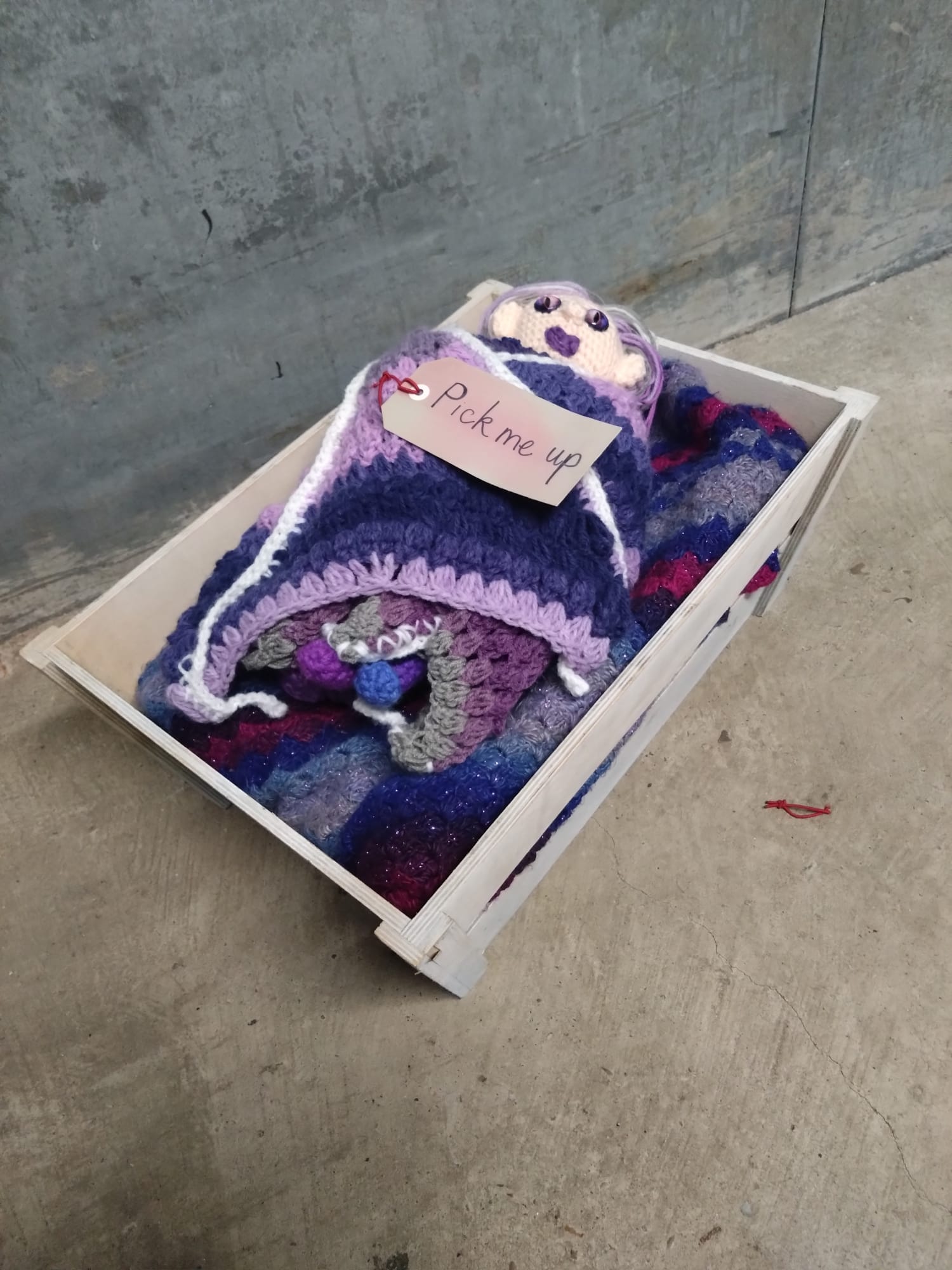
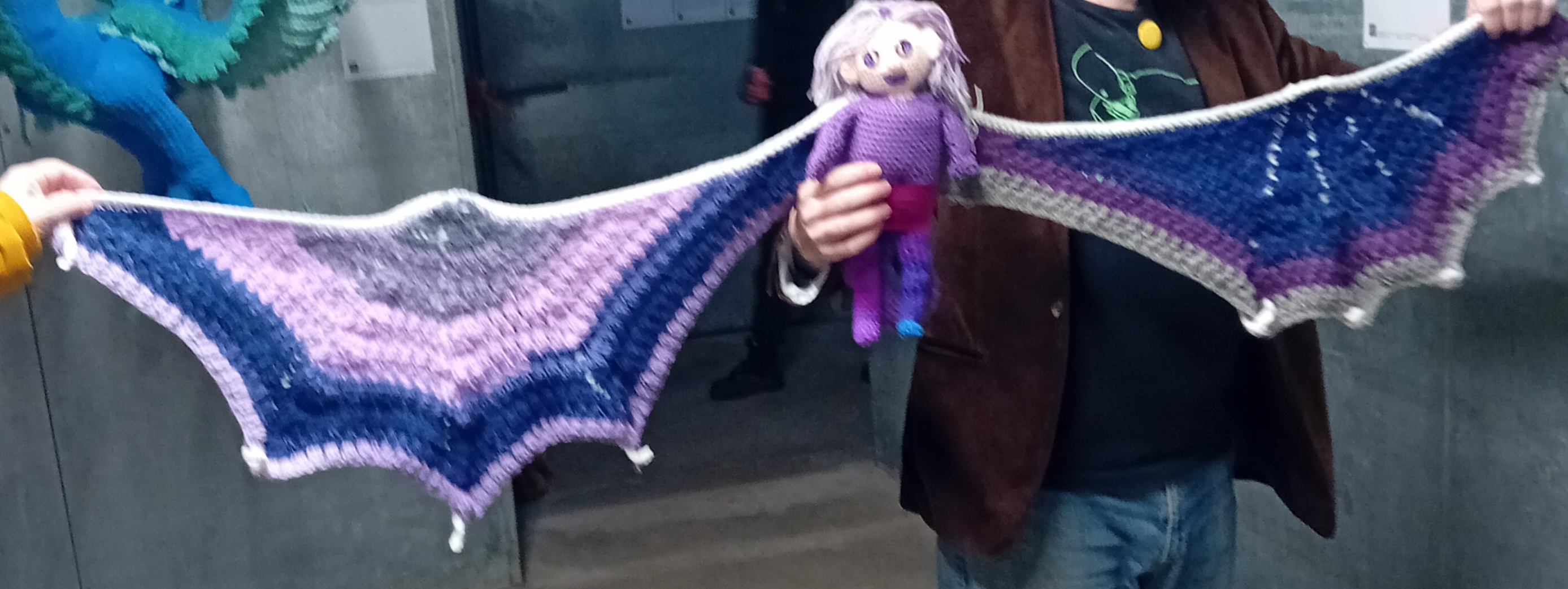
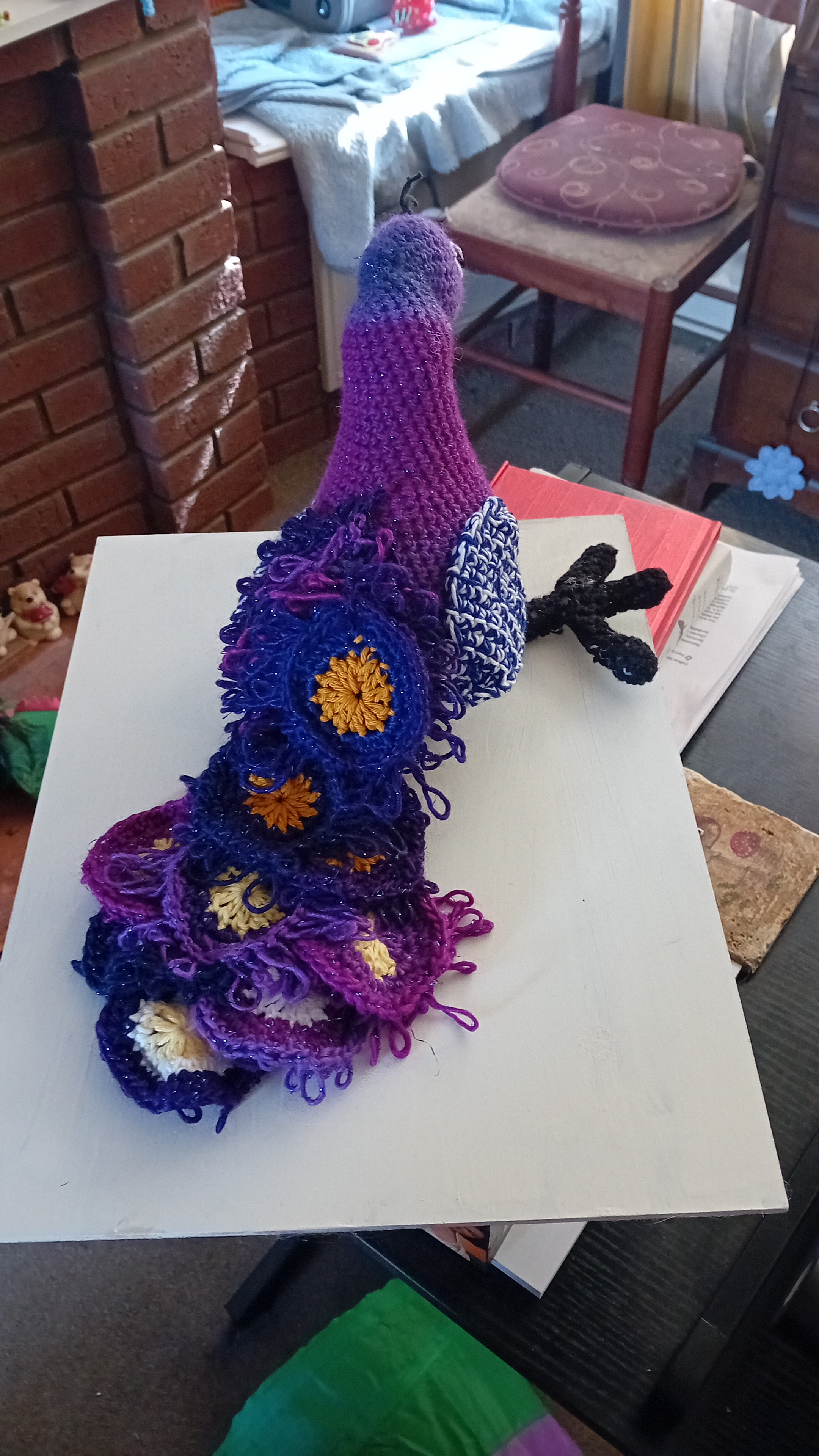
August was a busy month, with four blog tours and going to Autscape at the beginning of the month for work. I also needed to finish a crochet project for an exhibition at TT88 on 30th August, and a short story that I needed to finish and submit to Humber SFF by today.
I’ve also been reading books for the BFS Awards. I’m a judge for the Best Collection award. My fellow judges and I decided to have a deadline of 1st September, so I’ve been fitting them in around my tours. I also needed to read a book for a tour tomorrow.
The last week of August was very successful. I completed the crochet project, finished reading three books, and the short story.
I have other news, quite big news.
I work for an organisation that supports autistic adults, and have done for 5 years, but I’ve been involved with an arts organisation for several years as well. First the gallery, Turntable, hosted my Neurodivergent History project, and then my friend started Lucy’s Art Club, and it’s gone from there. I’m now a Director of a new organisation, Purple Peacock CIC, helping disadvantaged creatives in our region. At the end of the year I’m giving up my salaried job to take on self-employed work, both independently and with Purple Peacock CIC. I want to focus on my writing and creative work. I told my employer two weeks ago and it has been a weight lifted.
I feel like I’m able to access the creative part of me that was gradually locked up by my job taking all my focus.
I’ve also made contact with the editor at Spondylux Press about doing some proof reading and editing work for them. If you’re ND and want to find a publisher, I recommend Spondylux, I met the editor at Autscape and I will be reviewing two of the books I bought at a later date. Nema (the editor) is lovely.
In addition, I am going to build on the editing I’ve done with my current employer, for a couple of projects. I’ve edited short stories for authors and an anthology of art, poetry, memoir and short stories by Autistic authors. I have decided that I’m open for business self-employed as an editor and proof reader. See here for details.
Some of my projects with Purple Peacock CIC will be managing a reference library of poetry books we inherited, running a writing café, presenting writing and editing workshops for Lucy’s Art Club, and eventually, in several years, starting a small press for local disadvantaged authors.
There’s a novel I’m working on that’s only a few chapters in on the first draft. I’m planning to use up all of my annual leave in December, so I’ll have a whole, free month to write! Ahhh, it’ll be blissful!
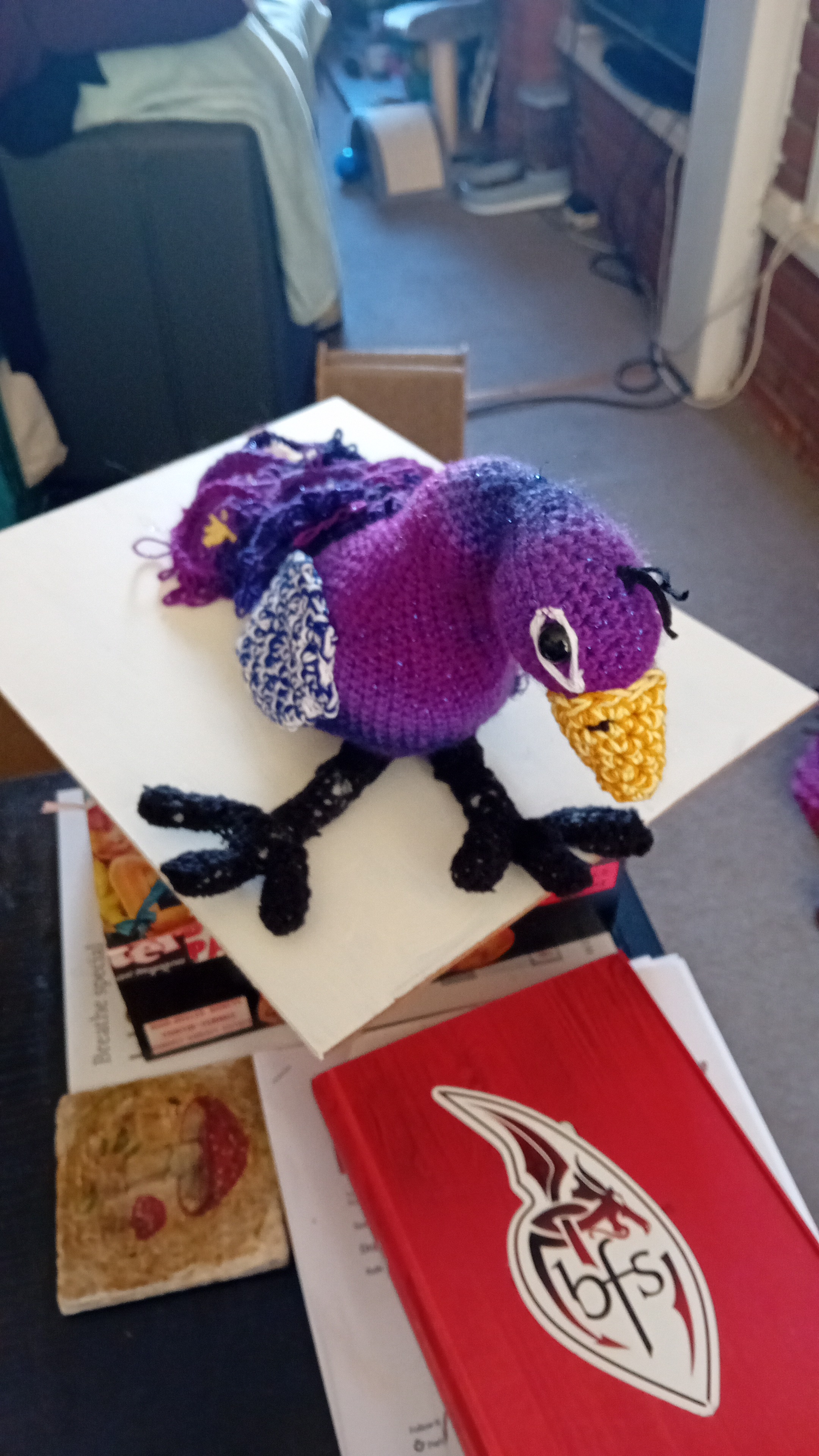
I’ve got loads of crochet projects to do too, but they’re personal projects. However, if you want a monster crocheting, let me know and I’ll cost it for you.




 Everything Is Better With Dragons