Format: 126 pages, Hardcover Published: October 14, 2025 by Head of Zeus — an AdAstra Book ISBN 9781035911448 Format: Audible Audio Published: October 14, 2025 by Head of Zeus — an AdAstra Book
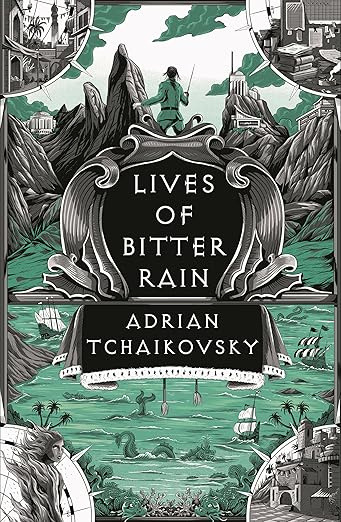
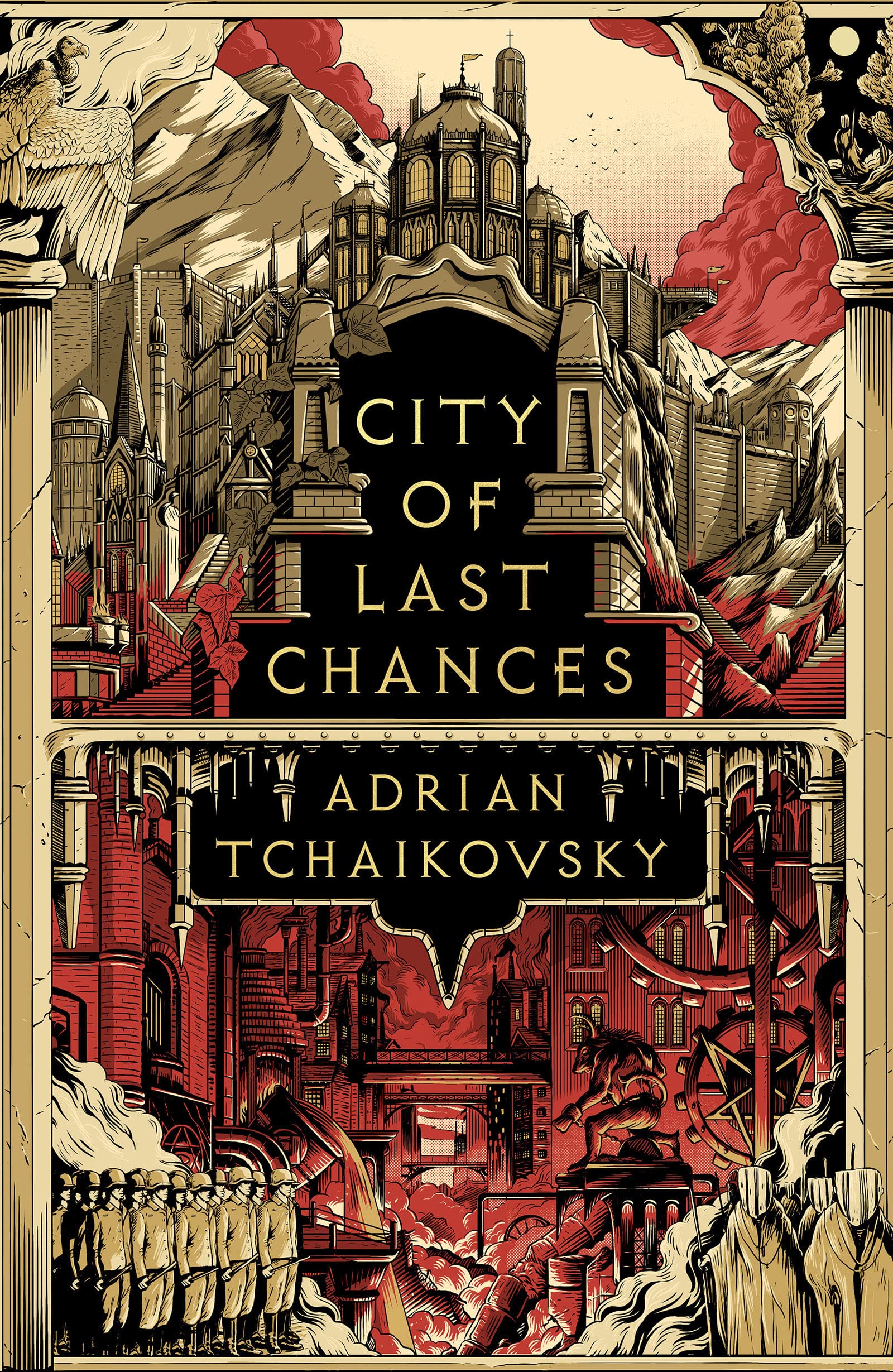
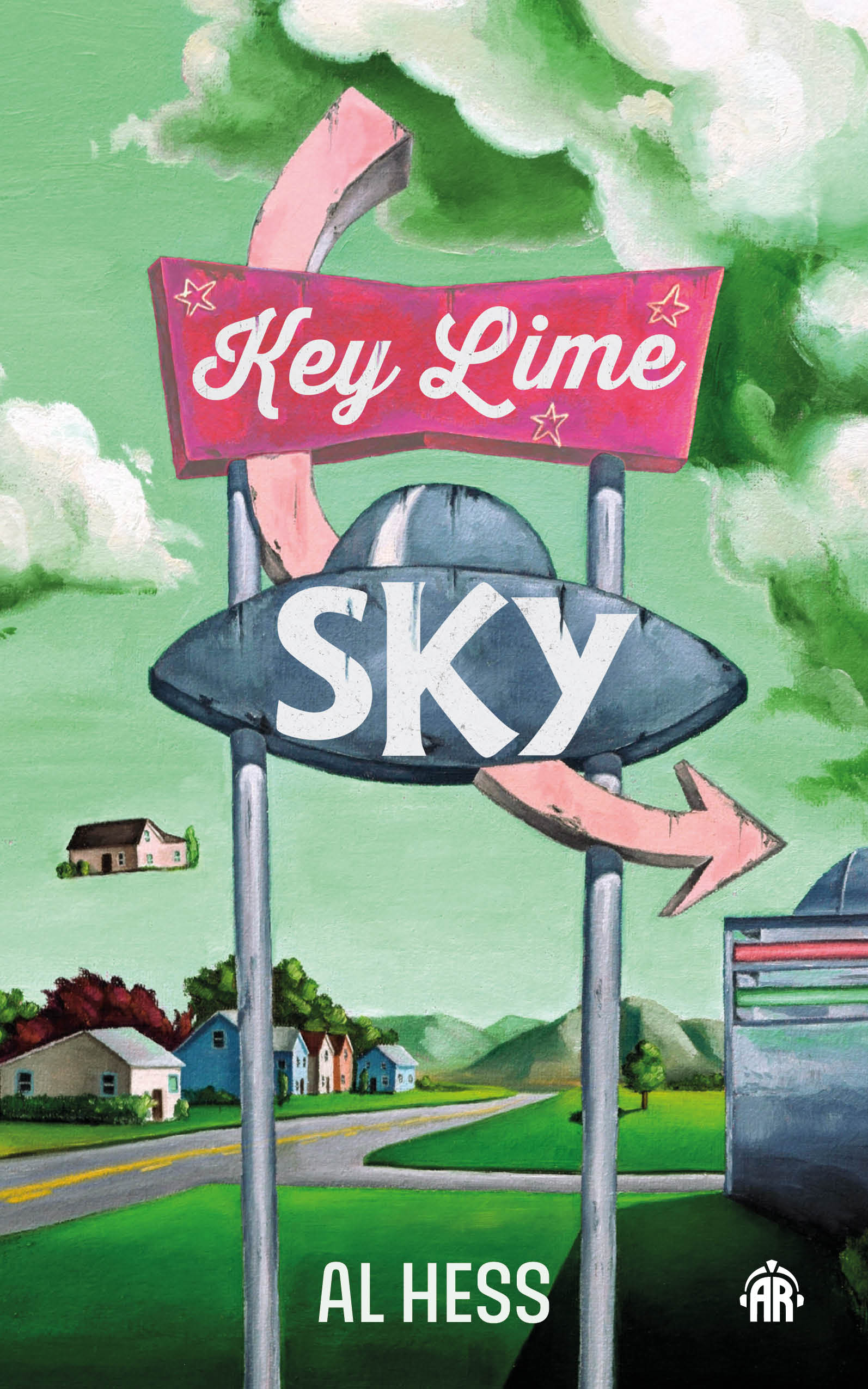
City-by-city, kingdom-by-kingdom, the Palleseen have sworn to bring ‘Perfection’ and ‘Correctness’ to an imperfect world. But before these ruthless Tyrant Philosophers send in their legions, they despatch Outreach – the rain before the storm.
Outreach is that part of the Pal machine responsible for diplomacy — converting enemies into friends, achieving through words what an army of five thousand could not, urging the oppressed to overthrow the bloody-handed priests, evil necromancers and greedy despots that subjugate them.
Angilly, twelve-years-old, a child of Pal soldiers stationed in occupied Jarokir, does not know it yet, but a sequence of accidents and questionable life choices will lead her to Outreach. As she travels from Jarrokir to Bracinta, Cazarkand, Lemas, The Holy Regalate of Stouk and finally, Usmai, she’ll learn that the price of her nation’s success is paid in compromise and lost chances, and that the falling rain will always be bitter.
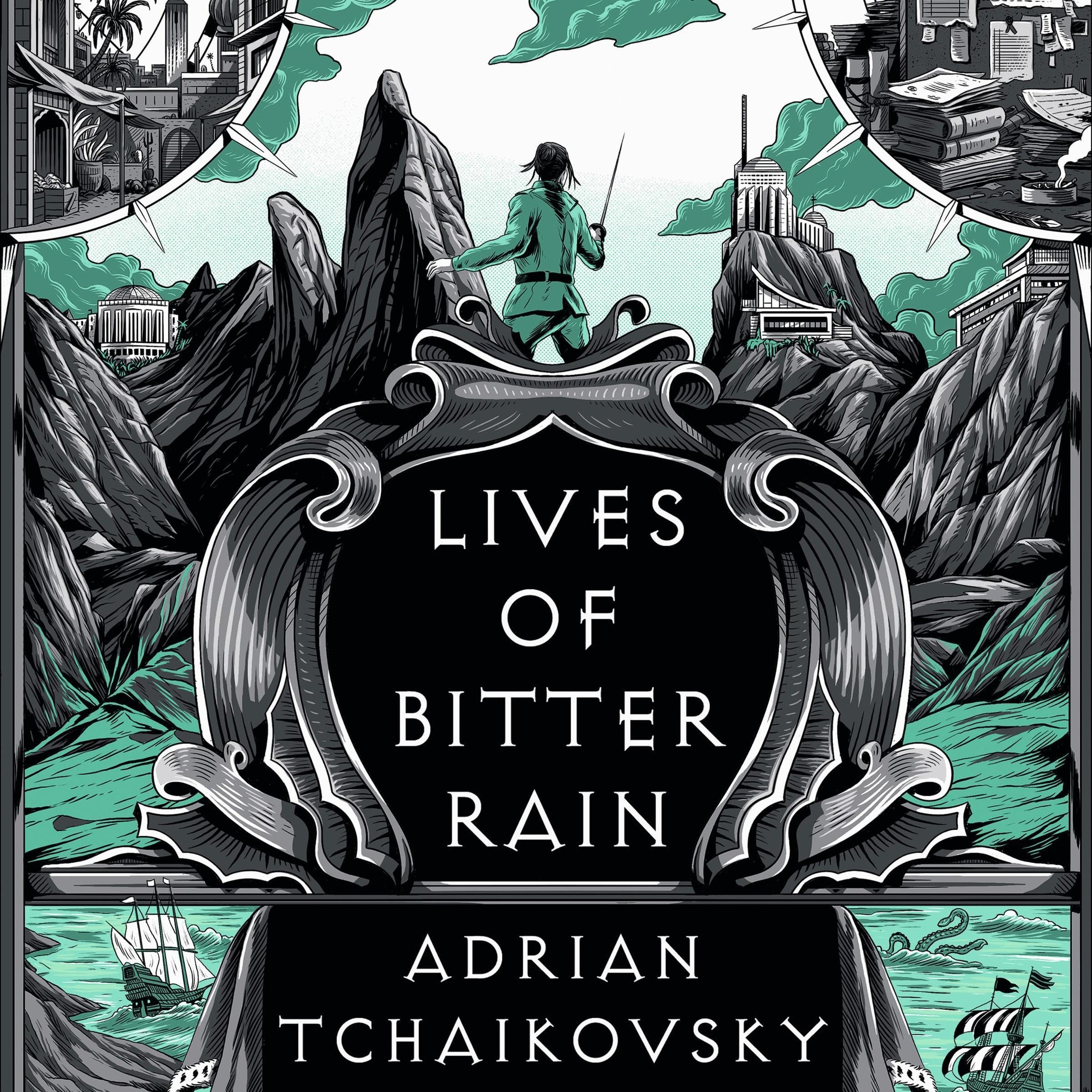
LIVES OF BITTER RAIN is a novella in Adrian Tchaikovsky’s award-winning Tyrant Philosopher series. It is a prequel to the third novel in the sequence, DAYS OF SHATTERED FAITH.
My Review
I’ve listened to all of the books in this series, and have them all in hardback, so obviously I had to get this novella.
We follow the life of Angilly from the time her parents die in Jarokir to the day she fights a duel in Usmai. Each important moment of her life as she rises to the rank of Resident is catalogued.
If you’ve read Days of Shattered Faith this will give you some insight into the actions and character of Angilly and extra background to the events in that novel. If you haven’t, you should, and this novella will give you a taste of the style of writing and the worldbuilding.
The narration is excellent as ever and it is easy to listen to. At just over 4 hours, this novella can keep you company for half a work shift if you can’t get away with reading at work.
They looked into darkness. The darkness looked back . . .
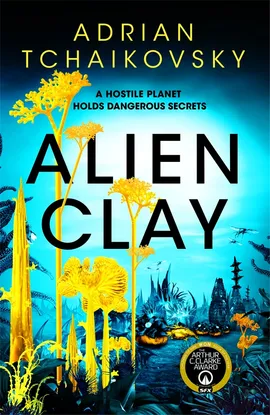
An utterly gripping story of survival and first contact on a hostile planet from Adrian Tchaikovsky, author of the Arthur C. Clarke Award-winning Children of Time.
A commercial expedition to a distant star system discovers a pitch-black moon alive with radio activity. Its high-gravity, high-pressure, zero-oxygen environment is deadly to human life, but ripe for exploitation. They named it Shroud.
Under no circumstances can a human survive Shroud’s inhospitable surface – but a catastrophic accident forces Juna Ceelander and Mai Ste Etienne to make an emergency landing in a barely adequate escape vehicle. Alone, and fighting for survival, the two women embark on a gruelling journey across land, sea and air in search of salvation.
But as they travel, Juna and Mai begin to understand Shroud’s unnerving alien species. It also begins to understand them. If they escape Shroud, they’ll somehow have to explain the impossible and translate the incredible. That is, if they make it back at all . . .
Format: Audible Audio Published: June 6, 2024 by Tor Language: English Narrated by the author
Description
To fix the world they first must break it further.
Humanity is a dying breed, utterly reliant on artificial labour and service. When a domesticated robot gets a nasty little idea downloaded into their core programming, they murder their owner. The robot then discovers they can also do something else they never did before: run away. After fleeing the household, they enter a wider world they never knew existed, where the age-old hierarchy of humans at the top is disintegrating, and a robot ecosystem devoted to human wellbeing is finding a new purpose.
My Review
I listened to this book through the ‘get one audiobook a month using Amazon Music’ thing, so I can’t keep it, but as soon as the book comes out in paperback, I’m getting it.
Charles is a valet robot who murders his master. But he doesn’t know why. Sent to be assessed and probably destroyed, he discovers freedom. He’s very confused by the world outside of the manor where he served is reclusive master for years. It’s all very disorderly and untidy. Estates are falling down, robot servants are rusting at their posts, and there’s no humans about.
Until Charles meets ‘The Wonk’. For the sake of Charles not getting crushed, The Wonk tells Charles, now going by UnCharles, that she’s a robot too. Despite all evidence to the contrary, Charles believes this to be the case almost to the end of the book. It is quite funny. UnCharles sets off to find humans to serve and The Wonk sets off to find the Library.
They meet later, and then go off on an adventure together, first to find the Library, and then to meet god. Turns out god is an A.I. judge, programmed to mete out justice. He also knows a lot about why Charles killed his master. And why the world collapsed.
Adrian Tchaikovsky can never be accused of not being political. His work always has a point. In this one, the subject of A.I. is discussed using humour and allegory. A.I. can only learn from what we feed it, it can only work within the parameters given.
Tchaikovsky also alludes to the compounds and bunkers wealthy people are building all over the world to escape to, when disaster strikes. They’ve managed to hoard all the wealth and destroy everything, and then they plan to run away when consequences occur. Since a lot of these people are the same people playing around with A.I. this is an easy inclusion in the novel.
But everyone dies. You can’t hide from death. Hopefully, the evil gits will die in attempting to run away and the resources they’ve hoarded can be share fairly among the survivors. (I don’t like billionaires.)
I enjoyed this novel, especially UnCharles’ confusion, and The Wonk’s sarcastic responses to his desire to serve. The vision of a destroyed wasteland was haunting and the critique of the way humans treat each other is spot on.
Series:Bobiverse (#5) Narrator: Ray Porter Format: Audible Audio Published: September 5, 2024 by Audible Originals Language: English
Description
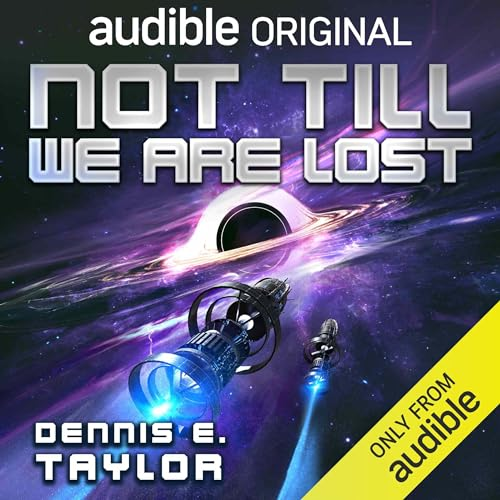
The number one best-selling series that Audible listeners call “wonderfully entertaining”, “packed with humor, geek references and thought-provoking storylines”, and performed by “a true master story teller and actor” returns as the Bobs face their deadliest challenge yet.
The Bobiverse is a different place in the aftermath of the Starfleet War, and the days of the Bobs gathering in one big happy moot are far behind. There’s anti-Bob sentiment on multiple planets, the Skippies playing with an AI time bomb, and multiple Bobs just wanting to get away from it all.
But it all pales compared to what Icarus and Daedalus discover on their 26,000-year journey to the center of the galaxy. Sure, it could settle the Fermi Paradox for good (and what Bob doesn’t want to solve a mystery of the universe?). But it also reveals a threat to the galaxy greater than anything the Bobs could have imagined.
Just another average day in the Bobiverse.
My Review
I might have done a happy dance when I got the notification that this audiobook was available, and even more when I realised I had an Audible credit to use.
I love the Bobiverse series and I always want to know what will happen next. In this instalment, we follow Icarus and Daedalus on their adventure to Sagittarius A* and their side-tracks, which leads them home at last, but with terrible news. It’s certainly an entertaining and clever solution to the Fermi Paradox, although I maintain my hypothesis that the other sentient species of the galaxy took one look at us and decided to leave us to our own devices because we were too much trouble. The second plot is Howard and Bridget’s adventures among the dragons. Another is the mission to develop wormholes, defeat the self-aware AI Thoth that the Skippies have let loose on the galaxy, and deal with increasingly hostile humans, while the Quinlans get their own ‘net and Charles makes a confession about the origins of Starfleet.
There are always a few plot lines in a Bobiverse book, because they’re an ensemble cast, but it gets confusing. I really enjoyed the different plots but I’d love it if I could just focus on one at a time! The plots are mostly linked, but sometimes they’re just separate stories. Howard and Bridget’s adventures among the dragons could have been a novella, for instance. I think Bob and Teresa’s story definitely needs more attention, too.
As ever, Ray Porter is a superlative narrator. I love his voice!
Overall, a great return to the Bobiverse, but may need more than one listen to get everything that’s going on. I shall be relistening soon.
Tor 8 March 2024 9781035013746 400 pages Audiobook narrated by Ben Allen
Synopsis
They travelled into the unknown and left themselves behind . . .
On the distant world of Kiln lie the ruins of an alien civilization. It’s the greatest discovery in humanity’s spacefaring history – yet who were its builders and where did they go?
Professor Arton Daghdev had always wanted to study alien life up close. Then his wishes become a reality in the worst way. His political activism sees him exiled from Earth to Kiln’s extrasolar labour camp. There, he’s condemned to work under an alien sky until he dies.
Kiln boasts a ravenous, chaotic ecosystem like nothing seen on Earth. The monstrous alien life interacts in surprising, sometimes shocking ways with the human body, so Arton will risk death on a daily basis. However, the camp’s oppressive regime might just kill him first. If Arton can somehow escape both fates, the world of Kiln holds a wondrous, terrible secret. It will redefine life and intelligence as he knows it, and might just set him free . . .
My Review
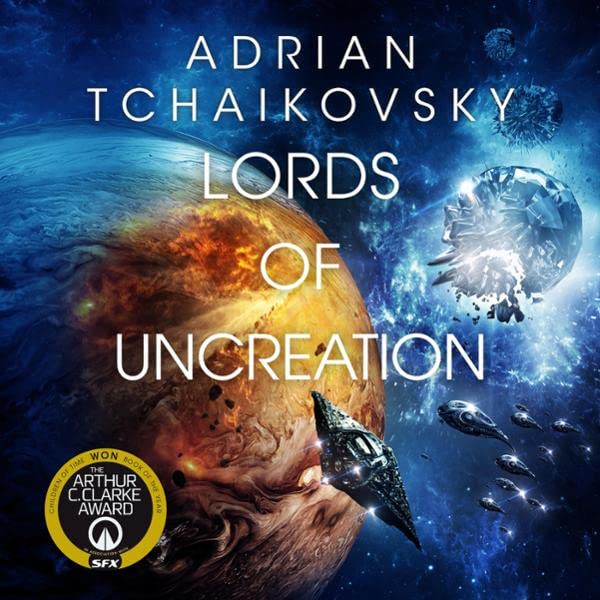
I ordered a hardback copy of this book from The Broken Binding and the audiobook from Audible. I started reading this book earlier in the week, after I finished reading Lords of Uncreation and decided I need some more SF. I should have been reading one of my blog tour books, but I’ll finish that tomorrow. I happened to need something to listen to on Wednesday because I wanted to go out and swim after I had to spend Tuesday at the hospital. I read the first 23 chapters of the hardback book on Monday, on Wednesday I picked up from the right point in the audiobook and listened to all but the last 23 minutes of it while I was out all afternoon. I listened to the rest when I went out today. So yeah, I binged the book slightly.
I’ve read eight of Tchaikovsky’s books now, six are from space opera trilogies, while two, including Alien Clay, are stand alone novels. I enjoy both types. There’s always strong worldbuilding and interesting characters. Alien Clay is no different, the world of Kiln is very deeply imagined and the main character, Arton Daghdev, is an acerbic bitch; he made me laugh so much.
Kiln puzzles the scientists bound by Mandate orthodoxy; Arton Daghdev and his fellow condemned are heterodox, rebels against the Mandate, or common criminals who happened to end up on Kiln as part of their punishment. Daghdev was an academic, skating the edge of orthodoxy, a xenobiologist, and a member of several revolutionary sub-committees, until purges put him on a ship to Kiln, a one-way trip.
On Kiln, he is welcomed by the very orthodox commandant who hopes Daghdev can be turned to orthodoxy. He’s put on the Science Support team, along with a friend from home, Ilmus, a former colleague and ‘disciple’ who was picked up by the police, tortured and exiled to Kiln a year before Daghdev. The team work with ‘the Science’ – professionals, paid to work on Kiln, to prove the Mandate’s anthropocentric orthodoxy.
Life on Kiln is rampant, even in an apparently cooler, drier period, and it evolves in a vary different way to Earth life. Each creature is a symbiotic community, carrying multiple species in many combinations. But ruins suggest there was once a sentient species on the planet, and it’s the job of the Science (and the prisoners sent to die there) to discover as much as possible and confirm the Mandate orthodox belief that the purpose of the universe is humanity.
After a failed coup, Daghdev, Ilmus and the former head of Science (who had a one night stand with Daghdev and is therefore assumed to have known about the rebellion), among others, are punished by being sent to Excursions. Where they are not popular, because changing the teams means changing the decontamination schedules, risking people’s lives.
Excursions are not a popular assignment, because they are the only people who go outside of the domed camp. Outside the camp, Kiln life tries to take hold immediately. Luckily, life is so different on Earth, that it takes Kiln life a while to work it out and a good decontamination can deal with that. It’s all well and good, until Daghdev’s team, led by an old shop steward, and longest living Kiln survivor, Keev, lose their transport to a creature called ‘the Elephant’s Dad’ and are forced to walk back to the camp.
Out in the Kiln environment, pretty much unprotected from the symbiotic life forms, they change. By the time they return, they are themselves and yet, more than that. Kiln has found the keys to unlock Earth biology. The planet has found a new mind that it can use. Slowly, the survivors spread their change across the rest of the prisoners, until they can work in unity while being still individuals. It’s a new revolution.
Tchaikovsky’s work has always had a political edge, if you know where to look, and he usually has a point to make. The point made in Alien Clay might piss off people who read sci fi because they like it when things get blown up in space and evil empires are replaced by less evil empires. Replacing one with t’other doesn’t work; you need a complete change of system. Replacing the Mandate with a revolution wouldn’t work – revolutions tend to get taken over by people who want power and will lie, murder, and steal to get it. The Russian Revolution is an excellent example of that. The impetus came from grass roots organisations to improve the lives of peasants and workers (the SRs and anarchists), and it was taken over by middle class idealogues who were interested in power – Lenin, Trotsky, and eventually the Bolsheviks under Stalin – and murdered their way through their former allies. Yes, life was probably better than under the Tsars for many people, but it was still shit, because power was still centralised under a ‘big man’ and small group of sycophants. Decentralised, local organisation, directly elected councils that can be recalled and replaced if they piss off the people, a lack of hierarchy, worked in some places for several years at a time, until Stalin and his collection of nut bags decided murder and invasion were better. The Red Army only won the Russian Civil War because of the Anarchist Army (the Red and Black) which voted for their officers. I’ve been listening to Cool People Who Did Cool Stuff, who are part way through a 6-part series on the Kronstadt rebellion, and Behind the Bastards, that’s just done a 4-parter on Stalin’s chief of secret police. Lots of cross-over there. I highly recommend both podcasts, by the way.
Reading Alien Clay when I’ve been listening to Behind the Bastards and Cool People Who Did Cool Stuff probably influenced my interpretation of the message of this book. It appeals to my socialist heart. Authoritarian regimes love a scientist or artist that’ll support their orthodoxy, because they need them to prop up their nonsense, but hates scientists and artists that use their intelligence and skills to point out the lies of the regime.
I love that Adrian Tchaikovsky has included an important, although secondary, character who is non-binary and probably Autistic in Ilmus. They’re the first to join the planet on the march back to the camp, the first to open themselves up completely to the whole. The tension between Daghdev and Ilmus, as they fear each other was the one who turned them in, and betrayed the rebellion at the camp, and the force of their friendship that helps them bridge the tension, is an emotional counterpoint to the humorous narrative of pain and confusion Daghdev feels on Kiln before the changes Kiln makes to them all.
The beings that live on Kiln are absolutely terrifying. I have a really strange phobia of parasites; the idea of things growing on me or taking up residence in me, and sprouting, absolutely terrifies me. That scene in Hannibal series 1 where they find bodies with mushrooms growing out of them, and one of the victims is alive with mushrooms sprouting from them, still horrifies me. So, I can’t say the species on Kiln don’t freak me out, but at the same time, it’s a really cool idea! Instead of the popular science understanding of competitive evolution, there’s a a species that specialises in one thing and will build a communal life with other species so that everyone gets their needs met. I love the way Tchaikovsky has his narrator describe the life on Kiln and events. It’s by turns lyrical, sarcastic and humorous. The stone crab that helps the marching Excursionistas get back to the camp is probably my favourite species.
The narrator of the audiobook was really good; I enjoyed the intonation and rhythm of the narration. At the end of the audiobook, there’s an interview between Adrian Tchaikovsky and Ben Allen, which covers Tchaikovsky’s influences and research. He originally studied zoology and then law, so Tchaikovsky has a background in science, among other areas; when he’s making up xenospecies it’s usually based in proper science. Which I appreciate.
I need to go to bed now, so I’m going to stop rambling and tell you to go buy Alien Clay.
) Published February 28th 2023 by Head of Zeus Hardcover, 460 pages Author: Django Wexler ISBN: 9781801101424 Format:460 pages, Paperback Published: February 28, 2023 by Orbit ISBN: 9780316519663 Publisher : Head of Zeus — an AdAstra Book (9 Nov. 2023) Paperback : 528 pages ISBN-10 : 1801101442 ISBN-13 : 978-1801101448Format: Audiobook Published: August 8, 2023 by Orbit ISBN:9781668634899
Blurb
Two siblings divided by magic and revolution must finally join forces and rally the people to take down the Twilight Order once and for all in the final book of this brilliantly imagined epic fantasy trilogy. The last surviving Chosen, Ashok has finally risen up and taken control of The Twilight Order. He promises equality and prosperity, but Gyre and Maya know the truth. Only death follows in Ashok’s wake. To take him down, Gyre will have to unite old allies from all across The Splinter Kingdoms and the depths of Deepfire. And Maya will have to seek out a legendary weapon hidden in the mountains that could turn the tide in their battle for freedom.














 Everything Is Better With Dragons