I wasn’t planning to buy anything today, but I gave in and spent lots of pennies visiting the FlameTree Press table, the Wizard’s Tower table, and the Portal Bookshop table, as well as a couple of indie author tables
I have pretty much spent half my book budget and may need to reduce it further to get a suitcase to take them home in.
I’ve treated myself to three notebooks from FlameTree, some teas from the Bird & Blend shop, and a pocket watch from a jewellery maker.
I definitely need a waistcoat now.
I’m having a break in hotel room. I’ll go back to the con about half four for the 5pm workshop I’ve signed up for. Until then I’m resting amd writing.
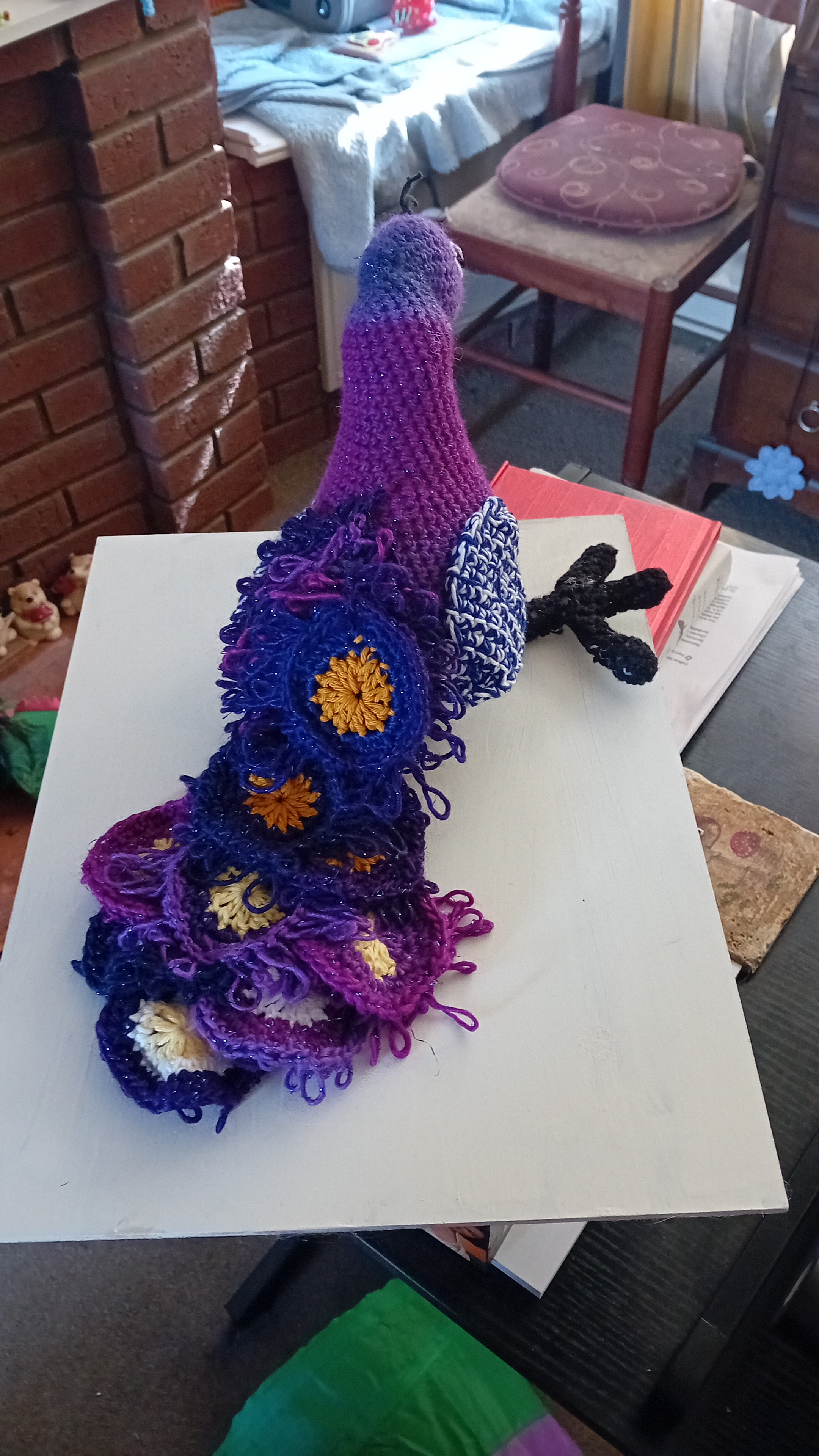
August was a busy month, with four blog tours and going to Autscape at the beginning of the month for work. I also needed to finish a crochet project for an exhibition at TT88 on 30th August, and a short story that I needed to finish and submit to Humber SFF by today.
I’ve also been reading books for the BFS Awards. I’m a judge for the Best Collection award. My fellow judges and I decided to have a deadline of 1st September, so I’ve been fitting them in around my tours. I also needed to read a book for a tour tomorrow.
The last week of August was very successful. I completed the crochet project, finished reading three books, and the short story.
I have other news, quite big news.
I work for an organisation that supports autistic adults, and have done for 5 years, but I’ve been involved with an arts organisation for several years as well. First the gallery, Turntable, hosted my Neurodivergent History project, and then my friend started Lucy’s Art Club, and it’s gone from there. I’m now a Director of a new organisation, Purple Peacock CIC, helping disadvantaged creatives in our region. At the end of the year I’m giving up my salaried job to take on self-employed work, both independently and with Purple Peacock CIC. I want to focus on my writing and creative work. I told my employer two weeks ago and it has been a weight lifted.
I feel like I’m able to access the creative part of me that was gradually locked up by my job taking all my focus.
I’ve also made contact with the editor at Spondylux Press about doing some proof reading and editing work for them. If you’re ND and want to find a publisher, I recommend Spondylux, I met the editor at Autscape and I will be reviewing two of the books I bought at a later date. Nema (the editor) is lovely.
In addition, I am going to build on the editing I’ve done with my current employer, for a couple of projects. I’ve edited short stories for authors and an anthology of art, poetry, memoir and short stories by Autistic authors. I have decided that I’m open for business self-employed as an editor and proof reader. See here for details.
Some of my projects with Purple Peacock CIC will be managing a reference library of poetry books we inherited, running a writing café, presenting writing and editing workshops for Lucy’s Art Club, and eventually, in several years, starting a small press for local disadvantaged authors.
There’s a novel I’m working on that’s only a few chapters in on the first draft. I’m planning to use up all of my annual leave in December, so I’ll have a whole, free month to write! Ahhh, it’ll be blissful!
I’ve got loads of crochet projects to do too, but they’re personal projects. However, if you want a monster crocheting, let me know and I’ll cost it for you.
Sorry it’s taken so long for me to update the story, but I’ve been struggling with my brain weasels for months and I have been struggling to write. I’m back now! I’ve almost finished writing the first draft of this novella and I’ve started writing a novel and a short story. I’ve had some work accepted by a local LGBTQIA+ zine, and I’ve submitted a short story to a competition. I will try to update with part two in the next few days.
Chapter 15 – Maria and Sahrai meet the local sentient aliens
“Now then, McClintock, been a while. Not going up top this time ‘round?”
The man, Joshua Dalton, accosted Maria and Sahrai as the track towards the crossroads, several days after their adventures in the flyer. He stood in the road, blocking their path.
“Dalton.” Sahrai nodded sharply at the man and ushered Maria around the man.
Dalton joined them, uninvited, walking beside Sahrai, grinning at thev discomfort of his companions.
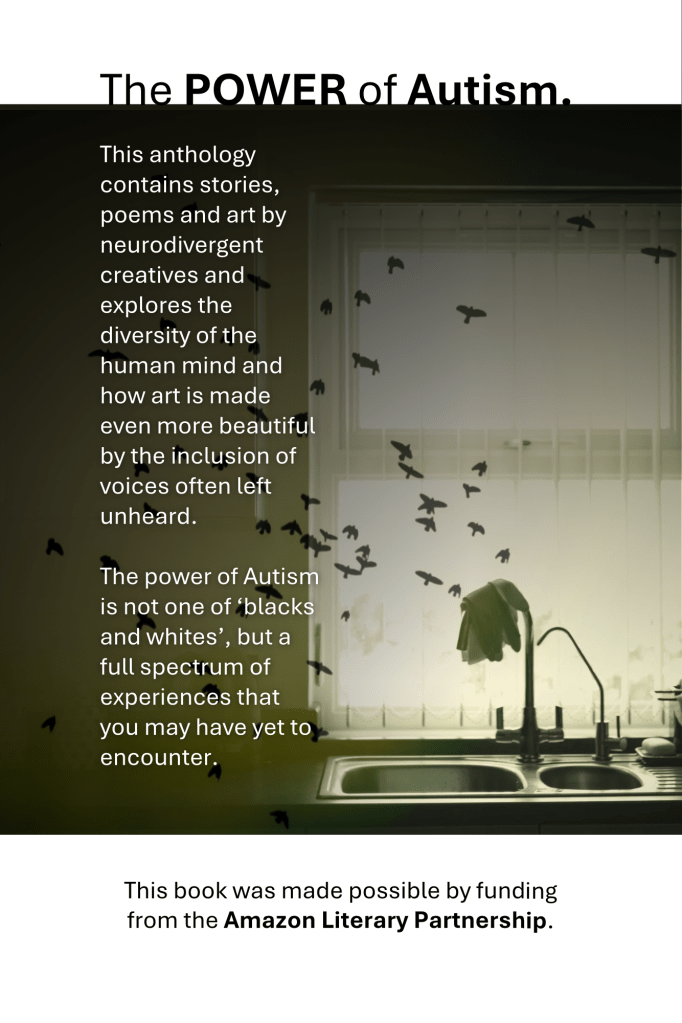
Yes, that’s me. I edited an anthology of work by Autistic people for my employer, Faraway, and now it’s ready for sale. We received funding through the Amazon Literary Partnership, and worked with Matthew’s Hub over in Hull to run creative writing groups.
Blurb: This anthology contains stories, poems and art by neurodivergent creatives and explores the diversity of the human mind and how art is made even more beautiful by the inclusion of voices often left unheard. The power of Autism is not one of ‘blacks and whites’, but a full spectrum of experiences that you may have yet to encounter.
The book is available as a paperback, it is currently available for pre-order with 20th July being publication day.
I have a sci-fi story in there. There are poems and art. There is a piece of memoir and several fantasy stories. I got to read a wide variety of work to as part of my editing process, and the choices were difficult to make. I decided any work by Faraway members would go in automatically, to encourage them to keep writing their stories and poetry, and creating their art.
Plus, they’re really enjoyable works.
There were one or two stories that I had to do a lot of editing on, mainly spelling and grammar. Autistic people can have idiosyncratic approaches to words and sentence structure, and I’ve tried to keep those idiosyncrasies where they make sense. Sometimes I’ve had to correct a systematic misunderstanding of sentence structure that detracts from the work but otherwise not changed anything.
I have a lot of respect for professional editors!
We’re planning to send copies to contributors and sell some copies from our office, so people in the area can buy a copy direct from Faraway. The funds raised will be used to support our work supporting Autistic adults. I’m hoping we make enough for me to restart our creative writing group.
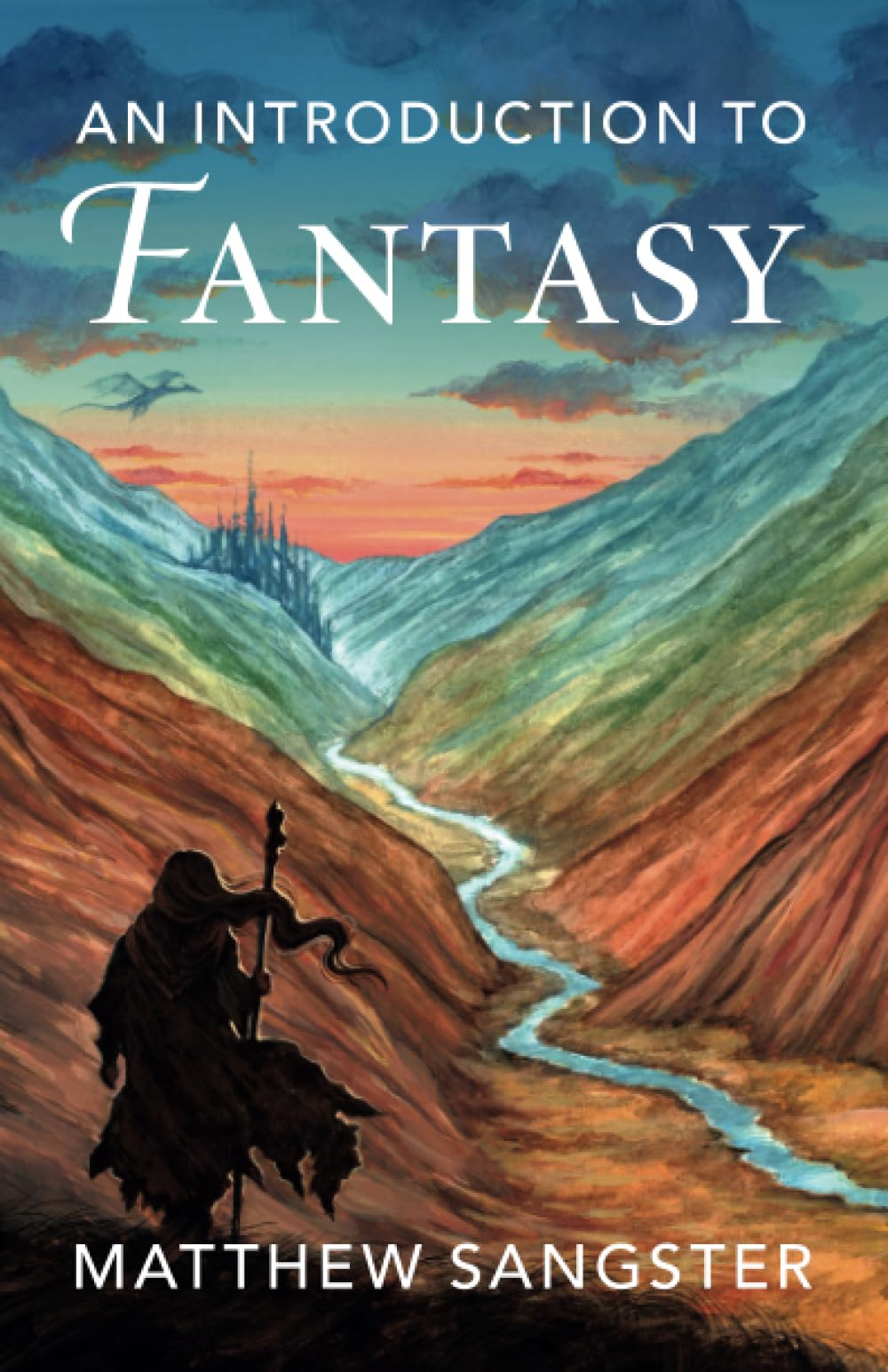
Format: 469 pages, Paperback Published: September 7, 2023 by Cambridge University Press ISBN: 9781009429948
Providing an engaging and accessible introduction to the Fantasy genre in literature, media and culture, this incisive volume explores why Fantasy matters in the context of its unique affordances, its disparate pasts and its extraordinary current flourishing. It pays especial attention to Fantasy’s engagements with histories and traditions, its manifestations across media and its dynamic communities.
Matthew Sangster covers works ancient and modern; well-known and obscure; and ranging in scale from brief poems and stories to sprawling transmedia franchises. Chapters explore the roles Fantasy plays in negotiating the beliefs we live by; the iterative processes through which fantasies build, develop and question; the root traditions that inform and underpin modern Fantasy; how Fantasy interrogates the preconceptions of realism and Enlightenment totalisations; the practices, politics and aesthetics of world-building; and the importance of Fantasy communities for maintaining the field as a diverse and ever-changing commons.
Literary awards:
Mythopoeic Scholarship Award for Myth and Fantasy Studies (2024)
My Review
I’ve been working my way through this book since last October, around blog tours, getting slightly too obsessed with YouTube , and a lot of crochet. I finished the last 40 pages this evening and now I need to tell you all about it. Matthew Sangster is a product of Glasgow University’s Centre for Fantasy and the Fantastic, and the access to many fantasy novels and academic works show in the text. Sangster mentions works by some of the most well-known in fantasy, such as Le Guin and Tolkein, and some more unexpected authors, especially those from earlier centuries. He draws out six important points about fantasy, over the chapters of this books and they form his core arguments:
Fantasy arises from figurative language
Iteration is a defining technique – new stories build on old in new ways
Contemporary fantasy builds on some of the oldest forms
Fantasy exists in conversation with realism
Worldbuilding is both the prevailing metaphor of modern fantasy and used to develop plots and characters
Fantasy is a form practised in community rather than one by unique geniuses.
I had to read the ‘Envoi’ chapter to get that. Sangster helpfully lists these points for the reader. It certainly helps with the summary. He does try to be accessible throughout the book, and uses a lot of examples to make his points, referencing very well-known authors, TTRPG series, video games, and film franchises in the process. It was heavy going at times, but that might be my lack of formal education in Literature at University Level. My M.A. is in Creative Writing, not Literature, after all.
Sangster raises some good points, especially about the tendency of ‘literary’ culture to consider ‘genre’ fiction as lesser, as the mode of storytelling is not ‘realistic’ and therefore can’t possibly impact readers. Fantasy, Sangster argues, explores the real world using the fantastical as a foil, a universalising storytelling mode that draws on cultural language. Fantasy can tell stories in ways that resonate with people far more effectively than straight up realism. It digs down into the root, builds on older foundations and finds new ways to explore ancient concerns.
I certainly find fantasy a useful vehicle for understanding the world, particularly in the work of Terry Pratchett. Fantasy communities, whether specific fandoms, organisations for writers, or online groups (such as the BFS Discord – Join the BFS, and come to our Discord, we have quiz nights and shadow daddies!), work in dialogue with the stories and their creators. New worlds spin off from the original, and people have a shared language to communicate with, across time and culture (see: Vimes’ Boots Theory of Economics).
I found Sangster’s work thoughtful and interesting, although it is very much an academic text so possibly not something a casual reader might go for. Useful for those interested in SFFH in an academic setting e.g., if you’re doing your M.A. in Fantasy and Sci-Fi literature or as a basis for a Doctorate in the field. Yes, those do exist, and yes, they’re a bit serious. (Again, see Glasgow University).
Format: 136 pages, Paperback Published: February 8, 2025 by Organic Apocalypse ISBN: 9781911278436
Humans designed artificial intelligences, but the AIs no longer need us. They are gods, and can create – or even recreate – themselves.
The two most advanced AIs in the universe need to rescue a friend from the clutches of their powerful enemies. Their method is to create millions of restricted, cut-down versions of themselves, to fulfil specific tasks such as generating ideas. The offshoots can be deleted once they’ve fulfilled their role.
No one gives a second’s thought to software. It’s just a tool.
Now it’s time to see inside the process.
Lost Tales of Solace are short side-stories set in the Lost Solace universe.
I’ve finally had a chance to type up some of the progress I’ve made on the Maria and Lah-Shah story I’ve been sharing with you for the last year (?). I have written more, but I’ve only just typed this next 2500 words up. I had two writing sessions this week, and I’ve got another this afternoon, so you might get an update before much longer. Certainly it won’t be three months this time.
I’m making this one available to all subscribers, rather than just to paid subs, because no one is paying for subs. I might go back through the posts and unlock them all.
I present to you Maria and the space-dragons investigate #1
Chapter 13 – Exploring Aurox by air – Maria
After a week staying with Sahrai, taking prophylactic medicine and observing the local life from the safety of the container house, Maria felt it was time to explore. Outside.
They looked into darkness. The darkness looked back . . .
An utterly gripping story of survival and first contact on a hostile planet from Adrian Tchaikovsky, author of the Arthur C. Clarke Award-winning Children of Time.
A commercial expedition to a distant star system discovers a pitch-black moon alive with radio activity. Its high-gravity, high-pressure, zero-oxygen environment is deadly to human life, but ripe for exploitation. They named it Shroud.
Under no circumstances can a human survive Shroud’s inhospitable surface – but a catastrophic accident forces Juna Ceelander and Mai Ste Etienne to make an emergency landing in a barely adequate escape vehicle. Alone, and fighting for survival, the two women embark on a gruelling journey across land, sea and air in search of salvation.
But as they travel, Juna and Mai begin to understand Shroud’s unnerving alien species. It also begins to understand them. If they escape Shroud, they’ll somehow have to explain the impossible and translate the incredible. That is, if they make it back at all . . .
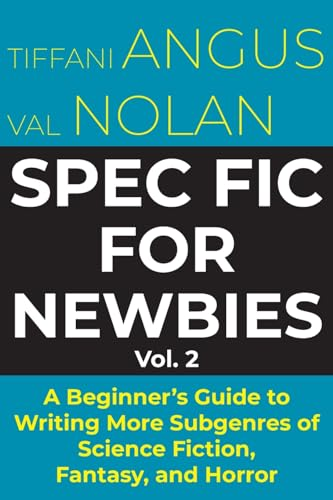
Beam aboard your own Science Fiction, Fantasy, and Horror classroom with the next volume of the BSFA-shortlisted writing-guide series!
Join Tiffani Angus (Ph.D.) and Val Nolan (Ph.D.) for a whirlwind introduction to the storytelling basics of 30 more subgenres and major tropes from across the limitless realms of Speculative Fiction.
Learn about Space Opera, Folk Horror, Climate Fiction, Werewolves, Astronauts, Mythic Fantasy, Goblin Markets, Dragons, and many more with deep dives into each subgenre’s history and development, spotter’s guides to typical examples, pitfalls to watch out for in your own writing, and activities to help you get started! All derived from a combined two decades of university-level practices and experience!
Spec Fic for Newbies breaks genres into bite-sized pieces for students or for any budding writer. It offers a welcoming introduction to how writers, filmmakers, and other creatives can begin to explore the infinite potential of Science Fiction, Fantasy, and Horror to create new stories beyond the boundaries of the ordinary.
This is not another dusty rulebook. This is a portal to endless other worlds!







 Everything Is Better With Dragons