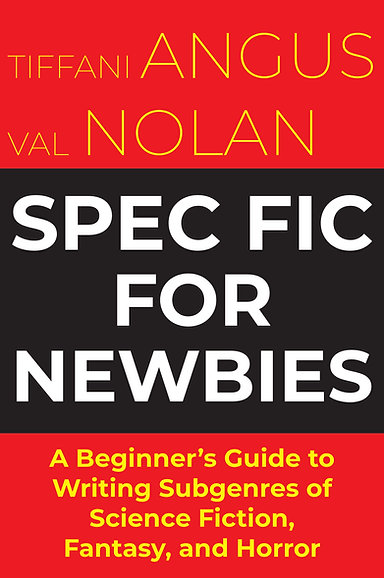
TBR Review: Spec Fic For Newbies, vol. 1, by Tiffani Angus and Val Nolan

Description

Release Date March 28, 2023.

Locus Recommended Reading List 2023
BSFA for Best Non-Fiction, Shortlist 2024
BFS for Best Non-Fiction, Shortlist 2024 

Spec Fic For Newbies: A Beginner's Guide to Writing Subgenres of Science Fiction, Fantasy, and Horror. Tiffani Angus (Ph.D.) and Val Nolan (Ph.D.) met at the 2009 Clarion Writers’ Workshop in California and since then have collaborated many times as fans and scholars on panels for SFF conventions and writing retreats.Working together on this book and combining their experience as SFF writers and as university lecturers in Creative Writing and Literature made perfect sense!

Every year they see new students who want to write SFF/Horror but have never tried the genres, have tried but found themselves floundering, or, worse, have been discouraged by those who tell them Science Fiction, Fantasy, and Horror are somehow not “real” literature.

This book is for all those future Science Fiction, Fantasy, and Horror writers. Tiffani and Val are approaching these three exciting fields by breaking them down into bite-sized subgenres with a fun, open, and contemporary approach.Each chapter contains 10 subgenres or tropes, with a quick and nerdy history of each derived from classroom teaching practices, along with a list of potential pitfalls, a description of why it’s fun to write in these subgenres, as well as activities for new writers to try out and to get them started!

My Review

I bought this book at FantasyCon 2023. I’ve got quite a collection of Academia Lunare books now, mostly genre stuff and Tolkien books. Look at the Luna Press Publishing website, under non-fiction and academic, to get a sense of the books I mean. Most of the are small, A6 size, usually with monographs on a uniting subject matter.

This book is different.

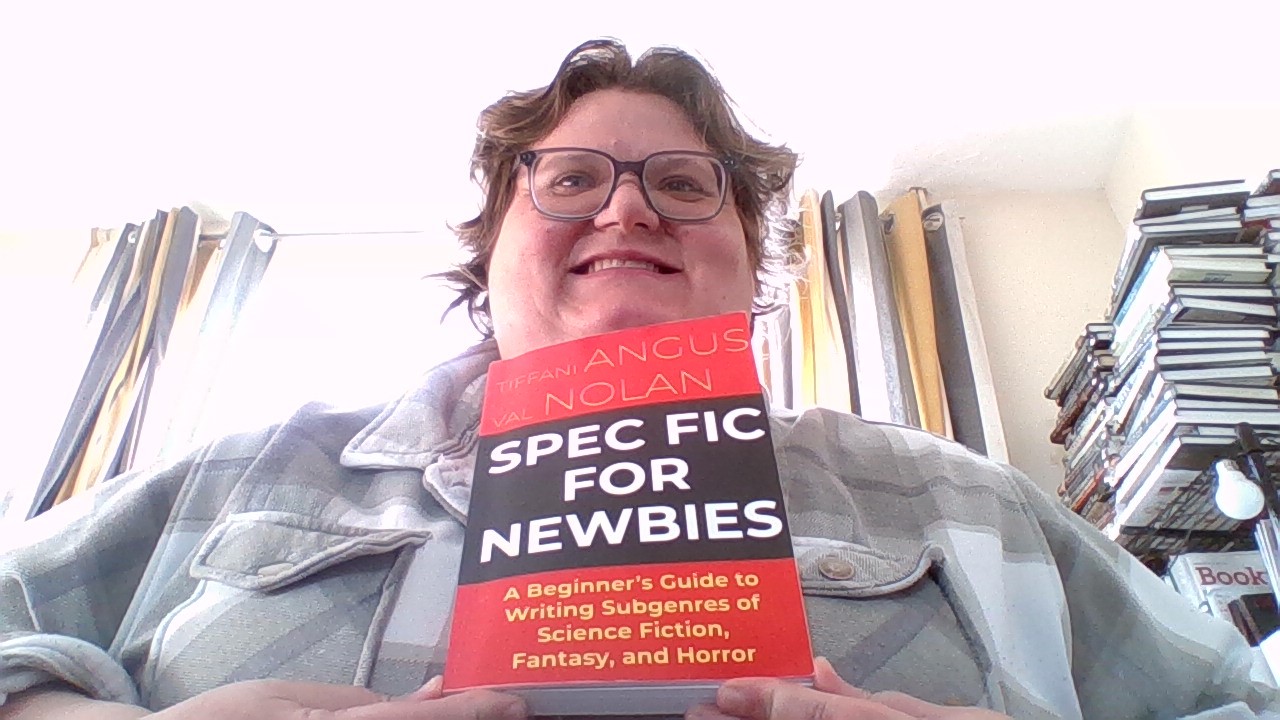
Yes, that’s me. I got the laptop camera to work properly. Yes, that’s the Pen & Sword TBR pile behind me.

It’s a guide to the sub-genres of SFFH, with two writing exercises for each sub-genre. I’m not exactly a ‘newbie’, but I don’t know all of the sub-genres, and it was interesting to read about the ones they included.

I enjoyed to quick tour and chatty writing style of this book, especially the genre and sub-genre histories. This book is informed by years of teaching by both authors, and it shows. They’ve clearly come across the same mistakes time and time again, but the enjoyment of both spec fic and teaching also really shines through. I could easily devour a volume on each sub-genre by these authors, but I’m weird like that. I like depth and breadth. I don’t think that’s a criticism of this book, but if you’re expecting in-depth discussions of the nuances of each sub-genre you’re not going to get that. The book provides broad overviews of each sub-genre with reference to specific tropes or movements within the sub-genre.

I enjoyed the tour of 30 sub-genres and the writing left me want more on some subject and no more about others (splatterpunk for example, is really not my thing). There’s enough to get you started on any sub-genre, and that’s what this book is for.

If you’re looking for something to read in a specific sub-genre, I think you could flip to the section in this book and find a place to start in a new sub-genre, because the authors provide lots of examples of works – both film and literary – that sit in a sub-genre.

There are also lots of references if you want to follow up on a particular statement or idea. I like references. More references and access to a database of papers, please. Because I don’t have enough to read…

I found the writing exercises prompted me to come up with new ideas and think it’ll be useful when I’m struggling to put an idea down on paper. I’ve got an idea about zombies and cruise ships, but it’s not going anywhere yet… Anyway, the activities make up a small section of each sub-genre entry, but the information packed in before them informs the activities. I think for a writer at any stage of their career, the activities will prompt the brain to try something new. If you’re a new writer they’ll give you a place to start, and for experienced writers they’re a reminder and refresher when your brain is fried. The writing advice found throughout the text is useful and explained well.

While I read this book from start to finish, I think it could be a good ‘dipping’ book, for those having a go at a new genre or sub-genre. There’s always something new to try – nobody could have written in all thirty of the sub-genres in this book – so dipping in and out as the mood takes you can give the writer practice in a variety of stories.

I have already recommended this book to a very new writer (my nibbling is doing creative writing as part of their OU Open Degree – I’m so proud!) and will be buying volume 2 at FantasyCon in three weeks – Francesca, make sure there’s a copy put aside for me, please!

I mentioned on my book Instagram that I was reading this book and Dr Angus kindly told me to contact her if I need any PhD advice, which I thought was lovely.

Tiffani Angus signed the book. It was signed when I bought it, so Tiffani must have been at FantasyCon last year.

And now, I’m going to bake some bread.

It’s Strange Up North event; or, Rosemarie went to Leeds and only bought 8 books

Bit of back story. A group of authors in Northern England and Scotland got sick of all the literary events being in London and decided to organise their own it Leeds. They arranged it with Waterstones and called the event ‘It’s Strange Up North’. 18 authors agreed to attend and the notifications went out.

I happen to be on the British Fantasy Society discord and heard about it, since one of the organisers was in the Yorkshire & Humber channel on the BFS Discord. I bought my ticket ASAP and waited. I had planned to go to Leeds for the entire weekend, but hotels are ridiculously expensive. It is my birthday weekend, or at least it’s the weekend closest to my birthday, so theoretically I could have had a whole weekend away but the cat didn’t agree.

Yesterday, I travelled to Leeds by train, went to Hold Fast Books after a ride on the water taxi, then meandered around the Armouries shop, and bought a dragon, got another water taxi back to the Granary Dock and made my way through the station and up Albion Street, stopping in for a pizza and pavlova at The New Conservatory in Albion Place, before heading just a bit further up Albion Street, to Waterstones.

It was packed! They sold out the event! It was catered. Or more precisely, the organisers had gone out and bought party food and told everyone to eat up because they didn’t want it to go to waste. I struggled, honestly. I wasn’t too fussed by the food, and there were too many people corralled into too small an area until the shop shut at 6.30pm. Once it shut, we spread out and took over all three floors.

I met Laura Lam, author of Dragonfall, Goldilocks, and several other books. I bought the paperback of Dragonfall and Laura signed it for me. We had a chat about random things, like epidermoid cysts, and the publishing industry.

I met Sunyi Dean, and her dog. She signed a paperback copy of The Bookeaters for me.

I met Stephan Aryan and got an early copy of The Blood Dimmed Tide. He signed it for me. Stephan Aryan is very tall. I got the first book in this duology, The Judas Blossom, last year at FantasyCon, and he signed that one there. I’m actually going to read both of them at some point.

I bought a copy of The Bone Ships, by R.J. Barker. He was supposed to be there but couldn’t, so sent signed book plates.

I met Charlotte Bond and got a copy of her debut novella, The Fireborne Blade. She was handing out sweets and bookmarks, so I’m not complaining. I read the book on my way home last night and a review will follow shortly.

I met Sarah Brooks, who signed a copy of The Cautions Traveller’s Guide to the Wastelands, her debut. It isn’t supposed to be out yet.

I picked up a copy of Ascension from Nicholas Binge. I think it’s the only sci-fi I bought.

And finally, Snowblooded, by Emma Sterner-Radley, a fantasy set in 19th century Sweden.

I have book marks for some of them, and in the goody bag I received an ARC of We Are All Ghosts In The Forest, by Lorraine Wilson and a pin badge for Snowblooded.

There are pictures on my Instagram.

P.S. Did you know the Royal Armouries shop has dragons!?

I bought a Suki brand dragon called Thunder. He is cute and has joined the dragons of my dragon shelf.

Maria and the Space-Dragons #1 – March 2024 instalment

Alright! We’re back with Lah-Shar and Maria’s adventures. This time we get some insight into Lah-Shar’s life and thoughts.

Chapter two – Lah-Shar

Lah-Shar felt the air change as they came closer to the base. He’d seen planets with ice sheets miles deep that extended almost to the equator. He’d seen planets that were tidally locked, one side burning the other freezing. His own planet, Ran-Nang, the one he was an egg and youngster on, had a warm damp climate except for the desert for 20 degrees either side of the equator. Ascend was chilly by Ran-Nang standards, but humans found it comfortably warm.

Continue reading “Maria and the Space-Dragons #1 – March 2024 instalment”

Introducing ‘Maria and the space-dragons investigations’ – a draft novella

Hello all,

I’ve been thinking about this for a while. I don’t like to make people pay for my work, but at the same time, I’m disabled, I can only work a few hours a week and the exhaustion is interfering with my ability to write. I want to give myself an incentive to write when I feel well enough. If I have paying subscribers, I have to write!

I may have mentioned the Space Dragon story I’ve been working on for a couple of years. The plan is to share a chapter a month for paying subscribers until I’ve written it all. You won’t be getting the first draft, since I write that by hand, but you’ll get the edited version. There will probably be further edits in future before I release it as a book. I might also share some of my short stories as paid subscriber posts.

What do you think?

Let me share a few paragraphs with you and if you want the rest, please feel free to join the paid subscription.


Update 22/03/2025

No one wanted paid subscriptions, so I’ve unlocked this chapter and any others that I’ve posted.

Continue reading “Introducing ‘Maria and the space-dragons investigations’ – a draft novella”

Trying to process why I write autistic characters and what I would like to know

I have occasionally joked that I learnt to be human by reading fantasy. What I mean by this is that fantasy explores so many different possible situations, so many different characters, that I was able to learn about human behaviour and psychology. I sometimes even learnt the appropriate responses to situations and why typical people do things that seem nonsensical to me.

Actually, most of the stuff they do is still nonsensical but I try to be tolerant. I’m probably more tolerant of the typical need to make small talk than most people are of my need to not make small talk, for example.

I write autistic main characters most of the time, it is sometimes deliberate, sometimes not. For me it helps to have a character that is trying to navigate a situation and to put myself in their place. I struggle to visualise things so I have to embody that situation instead. I can’t know how the character will react until I put myself there. I can usually work out how the other characters will react though, based on past experiences or reading, e.g. MC gets into an argument because the other person is in the wrong, other person either admits or gets defensive, MC will get upset and other characters will chide them for bringing up something that people don’t want to talk about. Creates conflict.

Or the end of the world is coming, Autistic MC has a sensible, logical plan, everyone else is panicking, how would they react? Baring in mind, my sisters and I regularly plan out what we’d do in even of a zombie apocalypse, and I have seriously considered preparing a go bag and clearing out the cupboard under the stairs to use as an emergency shelter, this is something I can ’embody’ fairly easily.

I have written accidentally autistic characters, who react and process their lives in an unconsciously autistic way and I have also written deliberately autistic characters. The difference is, when it’s deliberate there’s a purpose behind. In my Lucie Burns stories (especially my unfinished Dissertation piece) the purpose was to show a realistic autistic woman as a police officers, in opposition to the less than realistic and sometimes actively harmful depictions of autistic women in books and film/TV.

I’m currently working on a story for my writing group about a forensic psychologist who is autistic and helping to investigate a series of child murders (I go through phases of loving crime fiction and wanting to write crime all the time); I don’t have a defined purpose in this story, I just want to show an autistic person in a situation people might think unlikely – I don’t think people realise we make decent psychologists, teachers, social workers, etc. because they’re ‘people’ jobs and we don’t like people/have no empathy/all that nonsense. Also, I wanted to. I sounded like fun when I first planned the story out. I might even have my two autistic investigators meet in a future story, just for the hell of it. I expect their colleagues would all be ‘oh you’ll like (character), she’s autistic too’ and they don’t hit it off at all. Because we’re all human and different.

I do think representation is important, especially Own Voices representation, because for too long other people, typical people looking from the outside in, have defined us, defined our narrative and told the world they’re the experts. No, we are.

Anyway, I read a bit of fiction written by other autistic writers who also have autistic main characters, and I find it helpful, because other writer present other perspectives. I want to know if it’s deliberate, or their default character writing, I want to know their purpose, and reasoning. Is it hard to write about the difficult parts of being autistic, is it hard to write typical characters. I find my typical characters can be a bit flat, while my autistic characters tend to be more rounded. I actively have to try not to make older male typical characters bigoted boorish drunks, for example. Can’t imagine why…

I want to know about the writing process. I write almost a script first then have to go back and fill in the details, like body language and descriptions. Writing is an active process. I might get flashes of a scene in my brain but then I have to embody it to move beyond that. How do other autistic people work, especially if they have aphantasia?

I never know what my characters look like beyond an outline, and I actively have to pin things down as I write the story. I have face recognition problems if I haven’t seen people often or if I have haven’t seen them in a long time – especially with children. Do other writers have this problem, or do they know write from the start what their characters look like and will do?

How do they cope with characters of different backgrounds? I actively stick to white AFAB main characters, because I can’t begin to know what it’s like to be anything other than that. I have a limited ‘pool’ of friends and where I’m from isn’t diverse, so except for my BFF who is half-Egyptian and who has talked about what that means, and obviously I’ve observed, since we’ve been friends for 25 years, I don’t have much reference material. I don’t think it would be right for me to write a character from a different background if I couldn’t get a really detailed understanding of what it’s like to be someone who isn’t a white, working class AFAB person. I have an intellectual understanding of people’s experiences with discrimination and different cultural backgrounds but not the visceral understanding. I need to visceral understanding to embody a character. Is that just me, am I limited in my ability to ‘put myself in others’ shoes’ or is it a common thing?

Do autistic people, as readers and writers, use fiction to form their identity, as part of autistic culture or as a human in general? How does fiction help with this identity formation?

There’s so many questions, and I don’t know how to get the answers. I want to do a PhD on autistic writers and their autistic characters, but I don’t know how to phrase what I want to study, I don’t know where to start with applying for PhDs, either. It’s such a niche area, who would I even talk to?

Luckily, a new ‘neurodiversity and literature’ list serv has been started so I can ask them. If I get my courage up to ask all these academics with scary qualifications and careers.
Surviving ‘Outland’ with Rosie

I’ve listened to ‘Outland’ by Dennis E. Taylor and narrated by Ray Porter many, many times since I bought it earlier this year. Having entertained similar plots in the past but never written down (they were terrible, teenage fantasies) I have put some thought into the idea of how one would survive in a post-apocalyptic world. My sister has a similar thing with The Walking Dead and other zombie apocalypse series/films.

Anyway, time to play hypotheticals. I am in Lincoln, Nebraska, at the university for some reason.

Why would I be there? Am I visiting or living there?

A visiting lectureship in creative writing? Research for my PhD? A conference of some kind?

Yellowstone erupts.

I studied Earth Sciences, and was fascinated by volcanoes for a while. The subject of supervolcanoes came up in one lecture. I’ve read about them, I know what those beggars can do. As soon as Yellowstone started to do anything out of the statistical norm, I’d be finding an excuse to get on a flight back to England.

But let’s assume that for some reason I can’t get a flight home.

A bunch of students turn up at the university medical centre after the earthquake with a means to escape Earth. Their escape Earth, Outland, is a wilderness.

What will I need to survive?

  • Warm clothes
  • Boots
  • Waterproof clothes
  • Tent and camp bed
  • Sleeping bag and blankets
  • Food and water
  • Transport that doesn’t require fuel
  • Batteries and solar charging panels
  • Cooking stove and pans
  • Notebooks and pens
  • Books
  • Medication, including painkillers and a first aid kit
  • Toothbrush and toothpaste
  • Earplugs

Where would I get these from?

Well, if i was living in Lincoln, Nebraska, hopefully I’d have camping kit in my accomodation. Because it’s a rural state and there’s place to visit in neighbouring states. Not that I camp much these days. My back doesn’t like it and I like showers too much but let’s go with it. Clearly, at home I will also have medication and toiletries.

What about transport?

A bicycle with a trailer would work, even better would be an electric bike. It could be put up on blocks and used as an alternative source of power using the battery. A trailer would be useful for carrying the stuff and with chunky wheels on both the trailer and bicycle, the transport wound be able to handle the terrain.

I found some inspiration on this blog, just look at the dinky caravans pulled by bicycle! I particularly like ‘ The Wide Path Camper’ from Denmark, although it’s a one-off. It would save on a tent and camp bed, and everything could be carried in it.

Exoplanets, moon moons and the scientists of Lincolnshire

A few years ago, when I was looking around the University of Lincoln for my MA course, the guide, a 2nd year undergraduate, said he hadn’t known Isaac Newton was from Lincolnshire until he’d come to the University. I think he was from Nottinghamshire. Sir Isaac isn’t our only famous scientist however.

Continue reading “Exoplanets, moon moons and the scientists of Lincolnshire”

Dissertation news

Last Wednesday my dissertation arrived with notes and my final score: 65%

I was pleased but disappointed at the same time, because I’d really wanted a higher mark. I have high expectations of myself and felt I’d let myself down by only getting 65%. I’ve got over that now, almost. It sent me into a bit of a depression for a couple of days but I’m beginning to get through that. It hasn’t helped that I’ve been depressed anyway for the last two months. It’s easy for a little thing, like disappointment in my dissertation results to send me somewhere dark.

I’ve completed my amendments, which were mostly typos, because of my sticky ‘h’ key 😀 and submitted it via turnitin. I’ve got to get it printed and bound at the university library and hand it in by 12th December, so I’d better get on with that.

So, what else have I been up to?

I’m working on a short sci-fi story, that I hope will be the first in a series of three linked stories. A ship five hundred years from now is sent to retrieve a probe sent out two centuries before, but nothing goes to plan.

I’ve started another WEA course, the follow up to the one I did last year. So far we’ve covered using radiation to investigate crimes, like art fraud and injuries, and blood spatter patterns. Tomorrow it’s ‘UV light and high intensity radiation in crime investigations’, according to the lesson plan. Should be interesting.

I’m reading some books for next month’s review schedule, and other books I’me reading because I’m interested in them. Some will get reviews, some won’t. Depends on how I feel.

Right, that’s it. Enjoy the day.

My First Rejection

To be fair, this is the only publisher I’ve submitted to.

I heard back from Sara at Inspired Quill yesterday evening, although I only read it this morning. Unfortunately, they aren’t accepting Hidden Fire this time round but the advice she gave was really useful. I’m going to go back and look at both Hidden Fire and Fire Betrayed again, with her feedback in mind.

I was chuffed with this:

wonderful authorial voice that flows well and is a pleasure to read. Your characters are interesting, and it’s obvious that you know every detail about the world you’ve created.

… I like the way you don’t end every sentence with ‘said’ or ‘she shook her head’ (or similar!)…

I’m just sorry that currently, Inspired Quill doesn’t have the resources to offer you a contract and work with you.


The feedback boils down to:

  • Dialogue can be hard to follow when there are groups – non-verbal cues
  • More telling than showing – non-verbal cues
  • Episodic (good because keeps readers engaged) but needs a unifying arc running through.

The autistic writer has a problem with non-verbal cues and tone of voice. Now there’s a surprise! (This is a humorous comment, not a criticism of the feedback).

I can work with this. It’s not a problem.

I published Hidden Fire and Fire Betrayed a year ago, and I’ve learnt a lot since, especially during my dissertation writing. My supervisor, although a bit harsh at times, pushed me to write better, and his advice coincides with what Sara has written, to a certain extent.

Yes, it hurts my ego a bit and I’ll be shying away from doing anything for a while, but, I know how I react. Give me a couple of weeks and I’ll start work on them all again.


Completely random thought re: criticism and autistic people:

People say auties are rubbish with criticism, but I think it’s just a case of us needed longer to process and reflect so our automatic response is ‘nope, not happening, not doing it’, because, I at least feel like, when people criticise they expect immediate change and improvement and it’s just not possible, so ‘shut down and refuse’ is the go to response. Given time and no pestering, it’s possible to integrate the criticism into my worldview and work on it, but I need enough processing time (about two weeks). I don’t know if that’s how other auties feel, but that’s how it works for me. Maybe, instead of just listing ‘doesn’t respond well to criticism’, people should ask about how we feel and approach criticism, how we process and integrate it, instead?