The stand-alone sequel to ‘Moojag and the Auticode Secret’, endorsed by award-winning authors Patience Agbabi, Alex Falase-Koya, Ben Davis, and Daniel Aubrey.
A multigenerational story, featuring a neurodivergent cast and audhd, non-binary, POC, main characters, for readers 8 years and over.
When Nema returns to Gajoomdom, she discovers three forgetful grannies who have totally lost track of time. If she and Moojag can’t help them remember, everyone’s memories are in danger. But turns out not everyone is who they thought they were. Who will they rescue? Will they rescue them in time to save their perfect Real World from the nasty Conqip?
‘Lost Memories’, inspired by the author’s grandmother, and living with dementia and disability during the pandemic, shows us the impact of loss and the power of memory, as well as the importance of future technology when used for good.
Epilogue – A month (I.G.A.S.S. Standard) later, on Ascend
Maria flopped on to xyr settee, drained from spending all day on a video call giving evidence in the trial of the former human governor of Aurox. For a week xe’d been giving depositions against the regime on Aurox and their crimes, including the harassment Maria and Sahrai had received from Josh Dalton, the senior security officer. It had upset xyr when evidence of the abuse of the bovids had been presented and the testimony of human prisoners forced to labour on Rocky Horror.
Although a geologist by trade, Suah had been on enough new planets to have picked up basic skills in cultural analysis. Observing the Auroxians had been a distraction from the horror of events since arriving on Aurox. She shuddered, remembering the day the research party had been attacked.
I woke up feeling off so I had a steady morning and made my appearance at the con hotel in time for my second panel – Queer in Fantasy at noon. It was supposed to be streamed but staffing changes prevented it. Sian took another picture of me. I’m pointing at the book on the table, it’s I Want That Twink Obliterated from Bona Books. I was expressing my excitement.
Chris McCartney, Katie Bruce, and Christopher Caldwell were also on the panel, which was moderated by Burdock Broughton, who writes as April Steenburgh. I was beginning to feel unwell so I didn’t have much helpful to add. I mainly listened to everyone else and asked for a list of the books they’d all recommended. People have said that I made good comments but I have my doubts. I was overwhelmed and had brain fog for most of it.
After this panel I went to the quieter area and did some embroidery. I also made a quick visit to the dealer’s room to buy a book from AK Faulkner, Blind Man’s Wolf, and then planned to head to the ‘Creative Lives’ panel, but I got into the room and the bright lights were too painful, so I sat in the dark corridor, ate my sandwich and read Blind Man’s Wolf.
I attending the only reading I’ve been to this con, by Stephen Cox and AK Faulkner. Stephen Cox read from his Sapphic Victorian murder mystery, The Crooked Medium’s Guide to Murder, while AK read from Jack of Thorns and Blind Man’s Wolf.
After that I attended the ‘The Role of Reviewers’ panel in the same room. As a reviewer I was interested in how others saw their role, and also I didn’t need to more from the sofa I’d taken up residence on. Then I moved on to the Academic Hour, and listened to early career researchers talk about their research. The talk about Romanian folklore in fantasy was particularly interesting.
At six in the evening my throat started to feel scratchy, and I coughed my way through the ‘Editing and Editors’ panel. Luckily I was at the back and out of the way so I don’t think I bothered anyone. It was interesting, but by this point I was not able to take a lot in. I learnt that editors generally want the best for the writers and there is tension when they work for publishers because they have to balance the demands of publishing as an industry with the needs of the writers they work with.
At 7 p.m. it was the charity raffle. This is a Fantasycon tradition and stalwart Red Cloaks Babs and Marleen came through once again. They announced the ‘big prizes’ and were drawing the smaller prizes afterwards. I didn’t win anything.
Finally, at 7.30p.m. I made it up to the main room for the British Fantasy Awards. The awards were streamed although there were some technical difficulties.
This is a new award, organised in partnership with the BFS, BSFA, and UKIE to recognise excellence in World Building in Speculative Fiction, whether in books or games. It was presented by Brian Aldiss’ son, Tim.
The BFS awards were compared by Joanne Harris after Tim and Allen finished talking. I’m going to share the results, which are now available on the BFS website.
I judged this one so I already knew the winner. It was actually the first award to be presented after the Aldiss Award, but I’m working through a pre-printed list. The award was presented by Anne Landmann and collected by the author.
This award was presented by the venerable Suniti Namjoshi, a Guest of Honour at the Convention. It was collected by someone I vaguely recognise but I don’t know their name.
Presented by BFS Chair and excellent author, who’s new book I will be reviewing 6th December, Shona Kinsella. Award collected by editor, Ian Whates.
Best Newcomer – Frances White – Voyage of the Damned – Penguin Michael Joseph
Award presented by Taika Bellamy and collected by the author. I reviewed Voyage of the Damned and enjoyed it, but after listening to the Christophers at the Queer in Fantasy panel I’m wondering about the validity of m/m romance written by women. Who is the target audience?
This was presented by Ian Whates and collected by a representative.
BFS Art Competition
Sophie Jonas Will – Snicket and the Fireflies
Madelina Gaubelonga – The Long Wait
Carlie AF – Lonely Spire
The announcement was made by Jenni Coutts and the artists will have their work printed in the Autumn 2026 issue of Horizons, the BFS periodical.
BFS Short Story Competition
Mull, by J.W. Anderson
The Sphinx, by Marian Gordon
Iterate, by Nathaniel Spain
The announcement was made by Stephen Poore and the winners will have their stories published in BFS Horizons.
The Karl E Wagner Award – Rosemary Pardoe
This award is presented for outstanding contributions to the genre, and this year’s winner was a founder member of the BFS. Shona Kinsella made the announcement.
Legends of Fantasycon – Marlene and Babs the Red Cloaks.
This award is presented to people who make Fantasycon what it is – a joyous celebration of Fantasy. The award was announced by Karen Fishwick and eventually accepted by Babs and Marlene after they’d got a pint at the bar.
After the awards I had a drink with a group of friends and headed back to my hotel because I felt unwell.
Today I was on my first panel, The Way We’re Wired, about neurodivergence in fantasy. The moderator was David Green, and the other two panellists were Janet Forbes from World Anvil and indie writer Roxan Burley.
I was supported by a few people I know, and my friend Sian, deputy chair of the BFS, took a picture for me to commemorate my first panel.
Before this panel, I attended another panel, Mapping in Fantasy. The moderator was Adrian M Gibson and the panellists were Alicia Wanstall-Burke, James Logan, and Joy Sanchez-Taylor.
Joy Sanchez-Taylor is an academic from CUNY, James Logan is trad published, and Alicia Wanstall-Burke is indie published.
I have James Logan’s book The Silverblood Promise and I’ve bought all three of Alicia’s books based on the description of the maps. I really want one of Joy Sanchez-Taylor’s books, but academic books are expensive.
I made extensive notes on the conversation, so this is a bit of a summary.
The panel discussed their relationships to maps, expressing childhood memories of travelling with paper maps and learning to read them. For Alicia, maps also help her to write as they allow her to visualise a space and the way it effects the story. They discussed how the choices made on the presentation of a map can tell the reader something about the world. Joy Sanchez-Taylor especially emphasized the way reorientating the world can express and explore new ways of thinking.
The panel went on to discuss whether or not a fantasy needs a map. James Logan expressed that although he has maps of his world they aren’t included in his books because he likes to keep things malleable, so that he can move cities around if he needs to, giving him more options for the future. Alicia Wanstall-Burke brought up the question of who owns the map? A map might be a symbol of power or it might be a tool to navigate a territory and be subject to change as the land changes. James Logan, from his perspective as an editor in a major publishing house, expressed that it can be expensive to commission an artist and a cartographer, so changing the map for the next book in a series is not going to happen. Joy Sanchez-Taylor mentioned the importance of maps for visual learners and discussed the pressure on authors to have a defined map, but that they can have known and unknown areas so that the story world can expand.
Next, the discussion moved on to how the layout of the world affects the story. Alicia Wanstall-Burke discussed how the world can provide barriers to technology, information, and culture, and when cultures separated by the physical barriers meet, there can be conflict, and that can drive the story. James Logan likes to keep the world fresh for himself and for readers, so he sets each story in a different city, providing a sense of scale. They went on to discuss the way maps change perspective and the commissioning process.
I also attended the ‘Here be Dragons in Fantasy Fiction’ panel, (moderator: Charlotte Bond; panellists: Aliette de Bodard, Michael R Miller, Andrew Knighton). It was fun listening to other people who love dragons as much as I do, and I’ve got two of Aliette de Bodard’s books in my Amazon basket now, because Dragons and their murder husbands…
I attended Stewart Hotston’s book launch, and got myself a signed copy of Project Hanuman.
In the evening I attended the Disability in SFF panel, moderated by Annie Summerlee, with panellists Lizzie Alderdice, Susie Williamson, Katie Bruce and Kit Whitfield. I know Katie Bruce and Kit Whitfield and wanted to support them, as well as being interested in what they had to say. The panel was streamed and is on the member’s area of the WFC 2025 website if you didn’t get to see it.
After that, I attended the Flame Tree book launch. We got a lovely speech from Lee Murrey, a hilarious one from Ramsey Campbell, and an amazing reading from Anna Smith Spark. I treated myself to a stack of books from Flame Tree yesterday, but I was tempted buy more today.
After the launch I spent several hours chatting and drinking with friends and new acquaintances, until we got chucked out of the con bar and went down to the hotel bar, until I left at 1 a.m. We’ve overwhelmed the hotel slightly, I don’t think they realised how much SFFH people like to drink.
I wasn’t planning to buy anything today, but I gave in and spent lots of pennies visiting the FlameTree Press table, the Wizard’s Tower table, and the Portal Bookshop table, as well as a couple of indie author tables
I have pretty much spent half my book budget and may need to reduce it further to get a suitcase to take them home in.
I’ve treated myself to three notebooks from FlameTree, some teas from the Bird & Blend shop, and a pocket watch from a jewellery maker.
I definitely need a waistcoat now.
I’m having a break in hotel room. I’ll go back to the con about half four for the 5pm workshop I’ve signed up for. Until then I’m resting amd writing.
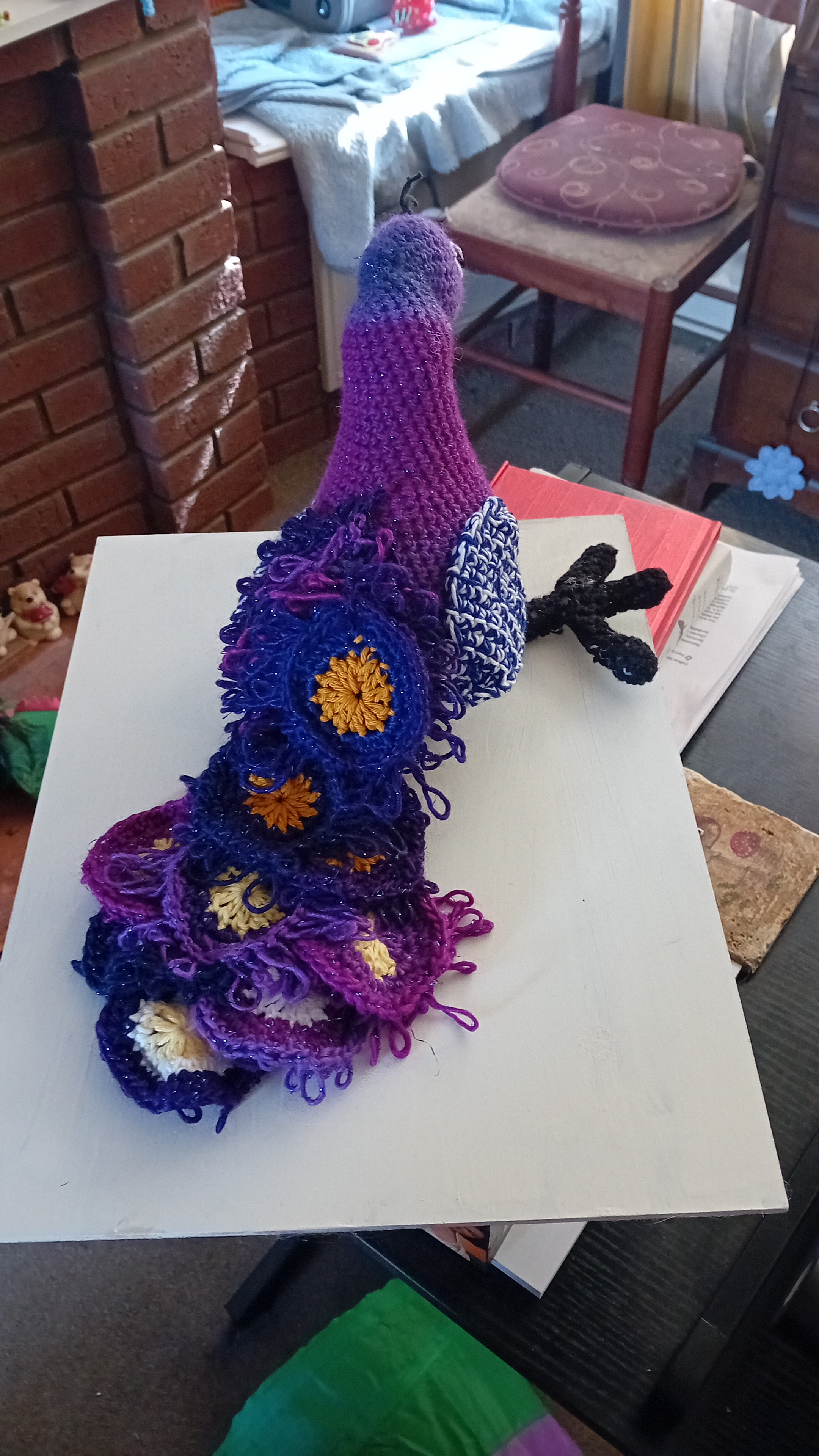
August was a busy month, with four blog tours and going to Autscape at the beginning of the month for work. I also needed to finish a crochet project for an exhibition at TT88 on 30th August, and a short story that I needed to finish and submit to Humber SFF by today.
I’ve also been reading books for the BFS Awards. I’m a judge for the Best Collection award. My fellow judges and I decided to have a deadline of 1st September, so I’ve been fitting them in around my tours. I also needed to read a book for a tour tomorrow.
The last week of August was very successful. I completed the crochet project, finished reading three books, and the short story.
I have other news, quite big news.
I work for an organisation that supports autistic adults, and have done for 5 years, but I’ve been involved with an arts organisation for several years as well. First the gallery, Turntable, hosted my Neurodivergent History project, and then my friend started Lucy’s Art Club, and it’s gone from there. I’m now a Director of a new organisation, Purple Peacock CIC, helping disadvantaged creatives in our region. At the end of the year I’m giving up my salaried job to take on self-employed work, both independently and with Purple Peacock CIC. I want to focus on my writing and creative work. I told my employer two weeks ago and it has been a weight lifted.
I feel like I’m able to access the creative part of me that was gradually locked up by my job taking all my focus.
I’ve also made contact with the editor at Spondylux Press about doing some proof reading and editing work for them. If you’re ND and want to find a publisher, I recommend Spondylux, I met the editor at Autscape and I will be reviewing two of the books I bought at a later date. Nema (the editor) is lovely.
In addition, I am going to build on the editing I’ve done with my current employer, for a couple of projects. I’ve edited short stories for authors and an anthology of art, poetry, memoir and short stories by Autistic authors. I have decided that I’m open for business self-employed as an editor and proof reader. See here for details.
Some of my projects with Purple Peacock CIC will be managing a reference library of poetry books we inherited, running a writing café, presenting writing and editing workshops for Lucy’s Art Club, and eventually, in several years, starting a small press for local disadvantaged authors.
There’s a novel I’m working on that’s only a few chapters in on the first draft. I’m planning to use up all of my annual leave in December, so I’ll have a whole, free month to write! Ahhh, it’ll be blissful!
I’ve got loads of crochet projects to do too, but they’re personal projects. However, if you want a monster crocheting, let me know and I’ll cost it for you.
Sorry it’s taken so long for me to update the story, but I’ve been struggling with my brain weasels for months and I have been struggling to write. I’m back now! I’ve almost finished writing the first draft of this novella and I’ve started writing a novel and a short story. I’ve had some work accepted by a local LGBTQIA+ zine, and I’ve submitted a short story to a competition. I will try to update with part two in the next few days.
Chapter 15 – Maria and Sahrai meet the local sentient aliens
“Now then, McClintock, been a while. Not going up top this time ‘round?”
The man, Joshua Dalton, accosted Maria and Sahrai as the track towards the crossroads, several days after their adventures in the flyer. He stood in the road, blocking their path.
“Dalton.” Sahrai nodded sharply at the man and ushered Maria around the man.
Dalton joined them, uninvited, walking beside Sahrai, grinning at thev discomfort of his companions.