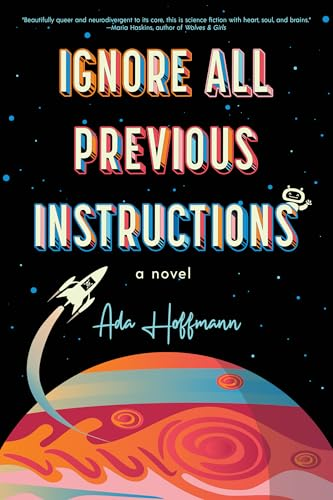
Published: May 12, 2026 by Tachyon Publications
ISBN: 9781616964566 (ISBN10: 1616964561)
Book Description
A script supervisor for an AI media conglomerate is caught between her intense need for an orderly life and her deeper, darker queer desires. From the creator of the Outside trilogy, a heartfelt interplanetary epic of identity, longing, and a space pirate who smuggles inappropriate stories.
Kelli Reynolds loves creating stories more than anything in the world. But on Callisto, a generative AI company called Inspiration owns everything, including all the media, and only Inspiration determines which stories can be told.
Kelli has a rare and coveted job in which her autism is to her advantage: She precisely edits AI output into “appropriate” stories for Inspiration’s massive TV audience. Her proudest creation is the pirate Orlando—a dashing do-gooder based on stories she used to tell friends.
Reenter Kelli’s ex-boyfriend Rowan, the person Kelli based Orlando on. Back when they were teenagers, their relationship was a secret. Kelli had thought that Rowan, a trans man, was her schoolmate Em, a girl.
Rowan is tangled up in the black market after he needed to get money for gender reassignment surgery. He needs Kelli’s help with something . . . illegal. So, now Kelli has to decide: Will she risk the safe, tidy story of her life now for the world she once wished for? What would Orlando do?
Passionate, dangerous, and tender, Ignore All Previous Instructions is a sweeping, poignant novel about censorship, forbidden love, and growing up.
My Review
I’ve known about this book for a while, because I get Ada Hoffmann’s newsletter. I got a NetGalley copy in April when I made myself go back to NetGalley, but I was struggling with the ebook version. Then my pre-ordered copy arrived on Thursday, and I started reading it yesterday. I have finished it after spending all day reading, non-stop, other than to get food. Totally immersed!
Kelli is autistic, and not the easy to empathise with cute child who is scared and shy type, but the screaming meltdowns, biting, punching type. I recognise her in me. When it all gets too painful and you can’t push the feelings down anymore, then it just explodes. Also, if you or your child are having screaming meltdowns, that’s a sign of some severely unmet needs. Instead of beating yourself or your child up for it (literally or figuratively), work out what that unmet need is AND MEET IT.
You can also be both the screaming meltdowns and the shy, scared type of Autistic, we’re complex like that.
Because we’re human.
Rowan is obviously ADHD, and as a child is misunderstood and bullied by teachers even if the kids all like him. Yeah, that sounds familiar too. Rowan’s need to transition and his need for stimulation lead him into a life that might be considered criminal. He smuggles illegal media to people in the Jovian system – that’s any media made by anyone not Inspiration.
Inspiration is the mega-corp that controls everything on Callisto. Its LLM is in everything and nobody can escape it. Human creativity is cut and controlled by models that decide on the appropriate content that will keep people happy. It’s a way to turn people into mindless robots while telling them that the company is generous and loving.
Kelli has tried not following the rules and it caused a lot of pain. Kelli tried to follow the rules and was successful – one of the 10% who had an actual job on Callisto, and one she finds fulfilling. She is a script supervisor for Inspiration, going through the outlines and scripts the genAI produces for a series featuring a character Kelli has developed since she was 8. But she can’t own the work or have her name on it, because that would be ‘stealing’ from Inspiration.
After a terrible event when they were 14, Rowan and Kelli don’t speak to each other for ten years. Rowan returns, having transitioned (in a world where transition is illegal and no one talks about Queerness lest it should ‘infect’ children) and asks for a favour. Would Kelli join him on a trip to Io to meet someone who really loves the series she’s written?
Reluctantly, Kelli agrees, and takes a few precautions, because Rowan is ‘bad’ and doesn’t follow the rules. It can’t just be talking to someone. She finds things are very much not the way Rowan said they were. For a start, the person they are meeting is the daughter of a crime boss and they want her to steal from Inspiration for the girl’s sixteenth birthday.
What follows is a heist that goes remarkably well, they get what they need and no-one gets hurt.
It all goes to hell when they get back to Io, and Inspiration’s law enforcement team arrive just at the critical moment. There is violence, explosions, a mad dash to the ship. It’s all very exciting. The emotional resolution is slow to come for Kelli but she finally works things out, just a little bit, enough to realise she wants to be with Rowan again, even if it means she loses her life on Callisto.
Their story as children is told in flashback chapters where we discover that Inspiration prevents children from learning that humans come in more than two binary heterosexual varieties, and children who look for information are prevented from learning anything. Trans people ‘don’t exist’ in this world, and what two adults do in private is no one’s business, but ‘we don’t want that in public’, so lesbian and gay people are shunned and bullied, seen as an inherant threat to children. Does that sound familiar?
Some people are so certain of their righteousness they don’t care who dies so long as they can have their exclusively cis het world. When Kelli and Rowan’s friend Elaine dies by suicide at the age of 14, Kelli decides to squash her queerness down, lock it in a box, and follow the rules. Rowan decides that he’s getting out as soon as possible. He’s already started sharing ‘illegal’ media among their tiny three person queer community, and finding ways to hack or us injection prompts to bypass controls on the computers and internet (what there is of it on Callisto) in order to jail break them, so it’s just a matter of scaling up, taking media to other frightened, isolated LGBTQIA+ people across the system, and helping to form a community.
Kelli is a realistic autistic character, Rowan is realistic as an ADHDer, while their friend Elaine has some clear mental health issues that the therapy bot is not helping. Therapy bots do not help, just like robots can’t help Autistic kids with social skills. Sorry, but trying to make us neurotypical as cheaply as possible won’t work. People with mental health problems need actual therapy and neurodivergent kids need to have their needs and learning styles respected. Just fucking do that.
These are two major parts of the narrative – neurodivergence and queerness. These are important to the author – they are autistic and genderfluid – and can speak with authority from experience of growing up in a system than pathologises both. This book benefits from that knowledge and experience; in providing realistic characters and experiences that the reader can relate to, Ada Hoffmann does what Rowan tries to do in the novel – give people stories about people like them. We all need to see ourselves in stories, being ourselves honestly and openly, finding hope and community in the stories, with other readers, and in the real world.
Reading the Afterward, I found a lot of common ground with the author, and appreciated the citations for their positions. I also understand the use of stories and using fiction to help interpret the world. I am not joking when I say I learnt to be human by reading books. Made for a strange combination at times, since I’ve liked fantasy since I was 12, but also read classics like Pride and Prejudice. Unlike me, Ada Hoffmann did something with their love of storytelling and makes a bit of a living from it.
Ada Hoffmann, under their legal name, is a PhD adjunct professor at a Canadian university, who works in computer sciences. They did their PhD in ‘creative computing’ – how can computers be used in creative work, what does it mean to sat a computer programme has been creative, that sort of thing. They thought LLMs would be used by creatives playing around and generating starting points. In the last few years, they have changed their approach, and done research into how the proliferation of LLMs/genAI has affected creatives – the damage it has done to writers and artists who live precariously as it is, including having their work stolen to train the LLMs.
LLMs are just scaled up predictive text, working from statistical analysis of what the next word in a sentence could be; they do not create, nothing they produce is original, and it amplifies any biases already present in the material it scrapes for training. The ‘artwork’ it creates is derivative and frankly bloody crap in most cases, it can’t do hands or faces, and videos are obviously faked – look for juddering on moving faces.
Basically, Ada Hoffmann is something of an expert in all the things this book is about. And they know how to write a good story. What’s not to like?
I really enjoyed the realistic space craft and space flight. The idea of sitting on top of an explosive in order to get out of a planet or moon’s gravity well does not appeal, as much as I’d love to travel the stars and see what’s out there. There’s also a discussion of how long it would take to get from Jupiter to Saturn, putting these things in perspective.
The colonies are described in enough detail to give each one its own character, and they also seem to be sensible renderings of what a colony on Callisto or Ganymede would mean.
Don’t go to Io.
It’s too volcanic for a colony.
Everyone will die.
This story was gripping, I raced through it, and I needed to know what was going to happen next. The emotional arcs were realistic and the ending satisfying. Highly recommended.


